
Working Smarter in the AI Era — Part 2
Artificial intelligence is rapidly transforming how businesses approach sales. From identifying high-value prospects to analyzing customer conversations and predicting buying signals, AI tools are becoming powerful assistants for B2B sales professionals.
But the real opportunity is not replacing salespeople with technology. The opportunity is helping sales professionals work smarter, make better decisions, and spend more time building meaningful customer relationships.
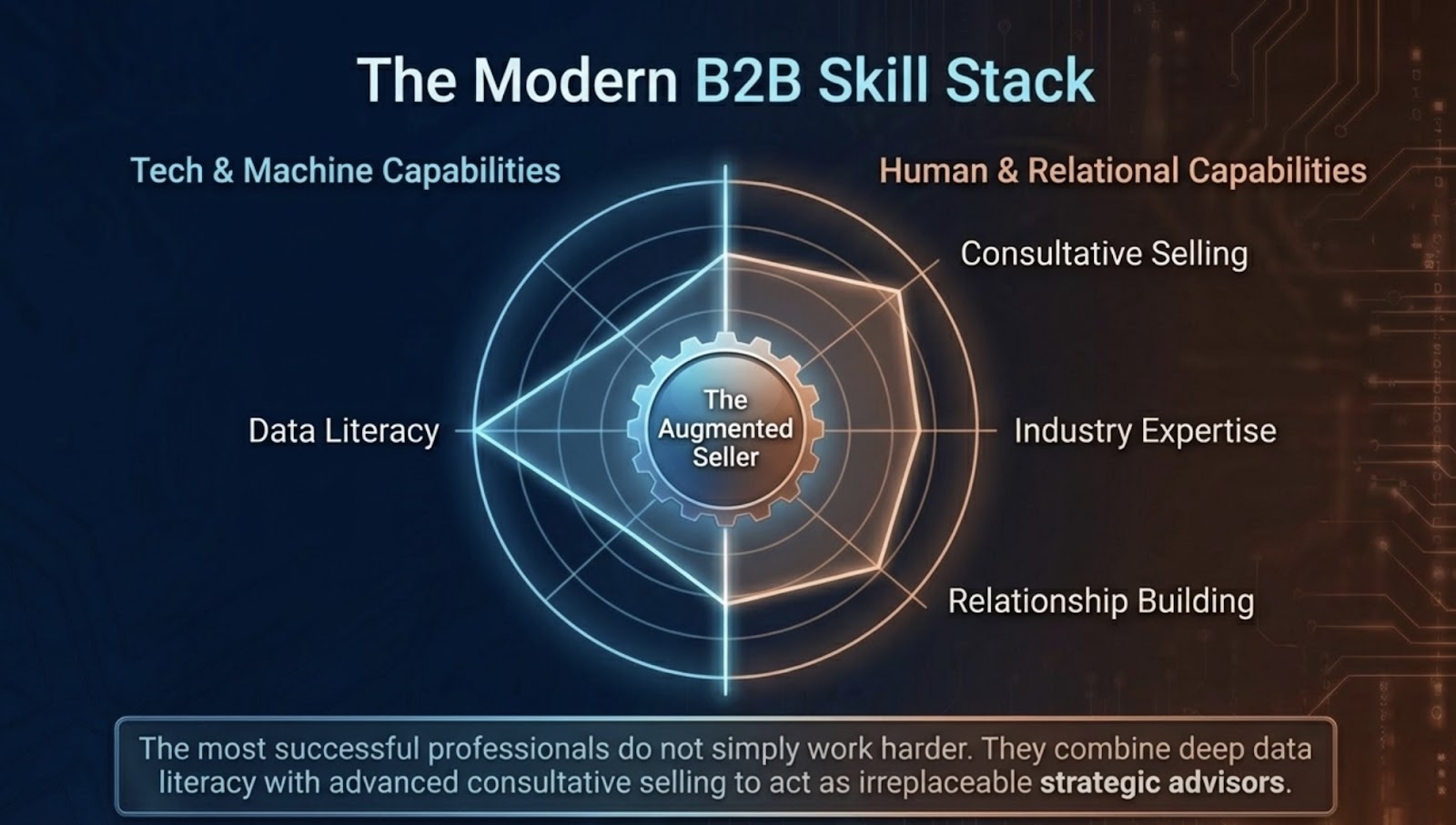
In today’s competitive markets, the most successful sales professionals are not those who simply work harder. They are the ones who combine human insight with modern technology.
Artificial intelligence allows sales teams to analyze large amounts of data, understand customer behavior more deeply, and identify opportunities that would otherwise remain hidden. When used effectively, AI helps sales professionals focus their energy where it matters most—solving customer problems and building long-term partnerships.
In this article, we explore how B2B sales professionals can use AI to improve prospecting, personalize outreach, shorten sales cycles, and ultimately close more deals in the modern AI-driven marketplace.
The Changing Nature of B2B Sales
Over the past decade, the B2B buying process has changed dramatically.
Modern buyers are more informed than ever before. They research products, read case studies, compare competitors, and evaluate pricing long before speaking with a salesperson.
According to research from Gartner, B2B buyers may complete up to 70 percent of their decision-making journey before contacting a vendor.
This means that by the time a conversation begins, buyers often already have a strong understanding of their options.
As a result, sales professionals must bring far more value to the conversation than simply presenting product information.
They must provide insights, guidance, and strategic thinking that help customers make confident decisions.
At the same time, sales teams face additional challenges:
• More competitors in global markets • Longer decision cycles • Larger buying committees • Higher expectations for personalization • Increasing complexity in products and solutions
Artificial intelligence helps sales professionals navigate these challenges by turning massive amounts of information into practical insights.
Instead of relying solely on intuition, sales teams can combine experience with data-driven intelligence.
How AI Is Transforming the Sales Process
Many sales technologies already include AI capabilities.
Modern customer relationship management platforms, analytics tools, and marketing automation systems increasingly rely on artificial intelligence to support sales activities.
Some common AI-powered capabilities include:
• Predictive lead scoring • Sales forecasting • Email and messaging optimization • Customer behavior analysis • Conversation intelligence • Pipeline insights
According to McKinsey & Company, companies that effectively integrate AI into sales processes can increase leads and appointments by more than 50 percent while reducing costs by 40 to 60 percent.
These improvements occur because AI allows sales professionals to focus on the opportunities most likely to produce results.
Rather than spending time on low-value activities, they can concentrate on building relationships and solving customer problems.
Using AI for Smarter Prospecting
Prospecting is one of the most time-consuming aspects of sales.
Sales professionals often spend hours searching for potential customers through directories, LinkedIn profiles, industry reports, and networking events.
AI-driven prospecting tools dramatically improve this process.
By analyzing large datasets, these tools can identify companies that show signals indicating a potential need for a product or service.
Examples of these signals include:
• Hiring trends • Technology adoption patterns • Company expansion announcements • Funding rounds or investments • Industry growth indicators • Changes in leadership
For example, if a company begins hiring several specialists in a particular field, that may signal a new strategic initiative.
Sales professionals who detect these signals early can engage potential customers before competitors even recognize the opportunity.
AI does not replace prospecting. Instead, it helps sales teams prioritize the right prospects first.
Accelerating Customer Research
Preparing for meetings with potential customers requires research.
Sales professionals need to understand the company’s business model, industry challenges, and current strategic priorities.
Traditionally, this process requires reviewing company websites, reading news articles, analyzing annual reports, and examining competitor activity.
AI tools can summarize this information quickly.
By analyzing publicly available information, AI can generate concise insights about:
• Company background • Industry trends affecting the business • Recent strategic initiatives • Potential operational challenges • Competitive positioning
This allows sales professionals to enter meetings better prepared and ask more thoughtful questions.
Preparation not only improves credibility but also helps sales professionals uncover opportunities to create real value for customers.
Improving Sales Communication
Cold outreach remains an important component of B2B sales.
However, generic emails or messages rarely produce strong results.
AI writing assistants can help sales professionals craft more effective communication by suggesting:
• Personalized introductions • Compelling subject lines • Clearer explanations of value • Alternative messaging approaches for testing
These tools can analyze previous successful campaigns and recommend improvements based on proven patterns.
Sales professionals should still refine messages using their own voice and experience. Authentic communication remains essential in building trust.
AI simply helps create stronger starting points.
Understanding Customer Conversations
Sales meetings and discovery calls often contain valuable information that can be difficult to capture manually.
AI conversation analysis tools can record and analyze discussions to identify patterns such as:
• Customer concerns • Frequently mentioned challenges • Competitor references • Signals of strong interest • Potential objections
These insights help sales professionals better understand what customers truly care about.
Some tools also highlight moments when prospects show excitement or hesitation, allowing sales professionals to adjust their approach in future conversations.
Over time, this analysis helps sales teams continuously improve their messaging and sales strategies.
Predicting Which Deals Are Most Likely to Close
Sales forecasting has traditionally relied on experience and judgment.
While those skills remain important, AI provides an additional layer of insight by analyzing historical data.
AI systems can evaluate factors such as:
• Customer engagement levels • Response time during negotiations • Proposal activity • Stakeholder involvement • Previous purchasing behavior
Using these signals, AI models can estimate the probability of closing specific deals.
Sales leaders can then allocate resources more effectively and focus attention on the opportunities with the highest potential.
Better forecasting also helps organizations plan revenue growth more accurately.
Automating Administrative Work
Sales professionals often spend a significant portion of their time on administrative tasks.
Updating CRM systems, documenting meetings, scheduling follow-ups, and preparing reports can consume many hours each week.
AI tools can automate many of these tasks, including:
• Automatic meeting summaries • CRM data entry • Follow-up reminders • Opportunity tracking • Pipeline analysis
When routine work is automated, sales professionals can dedicate more time to high-value activities such as building relationships and developing strategic accounts.
The Human Advantage in Sales
Despite the rapid advancement of AI, one truth remains unchanged.
B2B sales is built on trust.
Customers making major purchasing decisions want to work with professionals who understand their challenges and genuinely care about helping them succeed.
AI cannot replicate several qualities that define great sales professionals:
• Empathy • Strategic thinking • Negotiation ability • Relationship building • Deep industry expertise
In fact, as AI handles more data-driven tasks, these human qualities become even more valuable.
Sales professionals who combine emotional intelligence with data-driven insights will have a powerful advantage in the modern marketplace.
Skills Sales Professionals Should Develop in the AI Era
As AI becomes more integrated into sales workflows, professionals should continue developing several key capabilities.
Data literacy is becoming increasingly important. Sales professionals must understand how to interpret analytics and recognize when insights are meaningful.
Industry expertise also remains critical. Customers expect sales professionals to understand the broader business environment, not just the products they sell.
Consultative selling skills are becoming more valuable as well. Instead of focusing on transactions, sales professionals must act as advisors who help customers solve complex problems.
Finally, relationship building remains essential. Strong partnerships create long-term business value that cannot be replicated by automation.
The Future of AI in B2B Sales
Artificial intelligence will continue evolving rapidly in the coming years.
Future innovations may include:
• Real-time AI coaching during sales calls • AI-generated proposals and presentations • Predictive market intelligence • Advanced buyer behavior modeling • More sophisticated demand forecasting
However, the most successful sales professionals will not rely on AI alone.
They will combine AI insights with human experience, creativity, and judgment.
Those who learn to integrate these capabilities effectively will gain a significant advantage in increasingly competitive markets.
Final Thoughts
Artificial intelligence is not the end of the sales profession.
Instead, it represents a powerful new tool that helps sales professionals operate more intelligently and efficiently.
By combining human expertise with AI-driven insights, sales professionals can identify better opportunities, understand customers more deeply, and communicate more effectively.
In the modern marketplace, success will belong to those who learn to work smarter—not just harder.
If you are exploring how AI is reshaping different roles, you may also find these helpful:
References
Gartner. The New B2B Buying Journey https://www.gartner.com
McKinsey & Company. The Future of B2B Sales in the Age of AI https://www.mckinsey.com
Salesforce. State of Sales Report https://www.salesforce.com
Harvard Business Review. AI Is Changing Sales https://hbr.org
Disclaimer
This article is intended for informational and educational purposes only. The information provided reflects general trends and research related to artificial intelligence and professional workflows. It should not be interpreted as career, financial, or business advice. The adoption and effectiveness of AI tools may vary depending on industry, organization, and individual circumstances. Readers are encouraged to evaluate technologies carefully and consider professional guidance when making strategic decisions.