
Working Smarter in the AI Era — Part 1
Artificial intelligence is rapidly transforming how businesses approach marketing. From analyzing customer data to generating content ideas and optimizing advertising campaigns, AI tools are becoming powerful assistants for marketing professionals.
For many people working in marketing today, the rapid rise of artificial intelligence raises an important question:
Will AI replace marketers?
In reality, AI is far more likely to augment marketing professionals rather than replace them. While AI systems can automate repetitive tasks and analyze large amounts of data quickly, the strategic thinking, creativity, and emotional intelligence required for effective marketing still depend heavily on human expertise.
Instead of replacing marketers, AI is enabling them to work faster, analyze deeper insights, and focus more on high-value activities such as strategy, storytelling, and brand building.
Professionals who learn to collaborate with AI tools may gain a significant competitive advantage in the evolving marketing landscape.
This article explores how AI is changing the marketing profession, what opportunities it creates, and how marketing professionals can begin integrating AI into their daily workflows.
How AI Is Changing the Marketing Profession
Marketing has always relied heavily on understanding human behavior, analyzing data, and communicating messages effectively. Artificial intelligence is now enhancing all three of these areas.
Modern AI tools can assist marketers in many different ways, including:
generating marketing content
analyzing customer behavior
identifying audience segments
optimizing advertising campaigns
predicting customer preferences
automating repetitive tasks
personalizing customer experiences
These capabilities allow marketing teams to operate more efficiently while also making better-informed decisions.
The Rise of Data-Driven Marketing
One of the biggest advantages AI brings to marketing is the ability to process and analyze large volumes of data.
Marketing teams collect data from many sources, such as:
website analytics platforms
social media engagement
digital advertising performance
email marketing campaigns
CRM systems
Traditionally, analyzing this data required a significant amount of manual work. AI tools can now identify patterns and insights much faster.
For example, AI-powered marketing platforms can help marketers:
identify high-value customer segments
detect emerging trends in consumer behavior
optimize ad spending across platforms
predict which prospects are most likely to convert
Research from McKinsey & Company suggests that organizations using advanced analytics and AI technologies can significantly improve marketing efficiency and return on investment.
AI allows marketing teams to make decisions based on data rather than assumptions, which often leads to more effective campaigns.
AI and Content Creation
Content creation is one of the most time-consuming tasks in marketing.
Marketing professionals regularly create:
blog posts
social media content
advertising copy
email newsletters
landing page copy
product descriptions
Generative AI tools such as ChatGPT and Claude can assist with many of these tasks by generating drafts, brainstorming ideas, and suggesting alternative messaging.
For example, marketers can use AI to:
generate headline ideas
draft blog outlines
create variations of ad copy
summarize research reports
brainstorm campaign themes
These AI-generated drafts typically require human editing and refinement. However, they can dramatically reduce the time required to produce marketing materials.
Instead of starting from a blank page, marketers can begin with an AI-generated draft and focus their efforts on improving clarity, tone, and messaging.
AI and Personalization
Modern consumers expect personalized experiences when interacting with brands.
Artificial intelligence allows marketers to deliver personalized content at scale.
AI systems can analyze user behavior to recommend:
personalized product suggestions
tailored email campaigns
customized website experiences
targeted advertising
For example, e-commerce platforms often use AI algorithms to recommend products based on browsing history and purchasing patterns.
Streaming services such as Netflix and Spotify also rely heavily on AI to recommend content tailored to each user’s preferences.
For marketers, this level of personalization improves customer engagement and increases conversion rates.
Without AI, delivering personalized marketing experiences to millions of users would be extremely difficult.
The Opportunity for Marketing Professionals
Although AI can automate certain marketing tasks, it cannot replace the human elements that are central to effective marketing.
Successful marketing still requires:
understanding human emotions
crafting compelling stories
building brand identity
developing creative campaigns
making strategic decisions
AI tools can analyze data and assist with content creation, but they cannot fully replicate the creativity and intuition that experienced marketers bring to their work.
This means the role of marketers is evolving rather than disappearing.
Instead of spending large amounts of time on repetitive tasks, marketing professionals can now focus more on:
campaign strategy
brand storytelling
customer insights
creative direction
cross-channel marketing strategy
AI allows marketers to move from being primarily executors of tasks to becoming strategic decision makers.
Professionals who learn to use AI effectively may find themselves becoming more valuable within their organizations.
Practical AI Skills Marketing Professionals Should Learn
Marketing professionals do not need to become programmers or data scientists to benefit from AI. However, developing several practical skills can help them take full advantage of AI tools.
AI-Assisted Research
AI-powered research tools can help marketers quickly gather insights about:
competitors
market trends
consumer behavior
industry developments
Instead of manually reading dozens of articles and reports, marketers can ask AI tools to summarize key information and highlight important insights.
Learning how to ask clear questions and prompts can significantly improve the quality of AI-generated research.
AI-Assisted Content Development
Generative AI tools can assist marketers with creating various types of marketing content.
Examples include:
blog articles
email marketing campaigns
social media posts
ad copy
product descriptions
AI can also generate multiple versions of marketing messages that marketers can test in campaigns.
This makes it easier to run A/B tests and identify which messages resonate best with audiences.
Marketing Data Interpretation
AI analytics tools can summarize complex marketing data and highlight important patterns.
Marketers who understand how to interpret these insights can improve:
campaign targeting
messaging strategies
content performance
marketing ROI
Developing basic data literacy skills can help marketers make more informed decisions based on AI-generated insights.
Workflow Automation
Marketing workflows often include repetitive tasks such as:
scheduling social media posts
generating campaign reports
updating CRM data
sending follow-up emails
AI-powered automation tools can significantly reduce the amount of manual work required for these tasks.
Automation allows marketers to focus more on strategic initiatives rather than administrative tasks.
Prompt Engineering
Prompt engineering refers to the ability to communicate effectively with AI tools using clear instructions.
For marketers, effective prompts can help generate:
better marketing copy
more relevant research summaries
creative campaign ideas
improved messaging frameworks
Small improvements in how prompts are written can dramatically improve the quality of AI-generated outputs.
A Practical AI Workflow for Marketing Professionals
To understand how AI fits into marketing work, it helps to examine how AI tools can support a typical marketing workflow.
Step 1 — Market Research
Marketers can use AI tools to summarize industry trends, competitor strategies, and consumer insights.
This helps teams quickly understand the competitive landscape.
Step 2 — Campaign Idea Generation
AI can generate lists of campaign ideas based on product features, audience characteristics, or seasonal trends.
Marketers can then evaluate and refine these ideas.
Step 3 — Content Creation
AI tools can generate drafts for blog articles, marketing emails, social media posts, and landing pages.
Marketers can edit these drafts to ensure they align with brand voice and messaging.
Step 4 — Campaign Execution
Marketing automation tools can schedule and distribute campaigns across multiple platforms.
AI-powered systems can also optimize advertising campaigns.
Step 5 — Performance Analysis
After campaigns launch, AI analytics tools can analyze engagement metrics, conversion rates, and audience behavior.
These insights help marketers refine future campaigns.
AI Tools Worth Exploring for Marketing Professionals
Several AI tools are becoming widely used in marketing workflows.
Some popular examples include:
ChatGPT https://chat.openai.com
Claude https://claude.ai
Microsoft Copilot https://copilot.microsoft.com
Perplexity AI https://www.perplexity.ai
Notion AI https://www.notion.so/product/ai
Each of these tools offers different capabilities, including research assistance, writing support, workflow organization, and analytics.
Many marketing teams use a combination of tools depending on their needs.
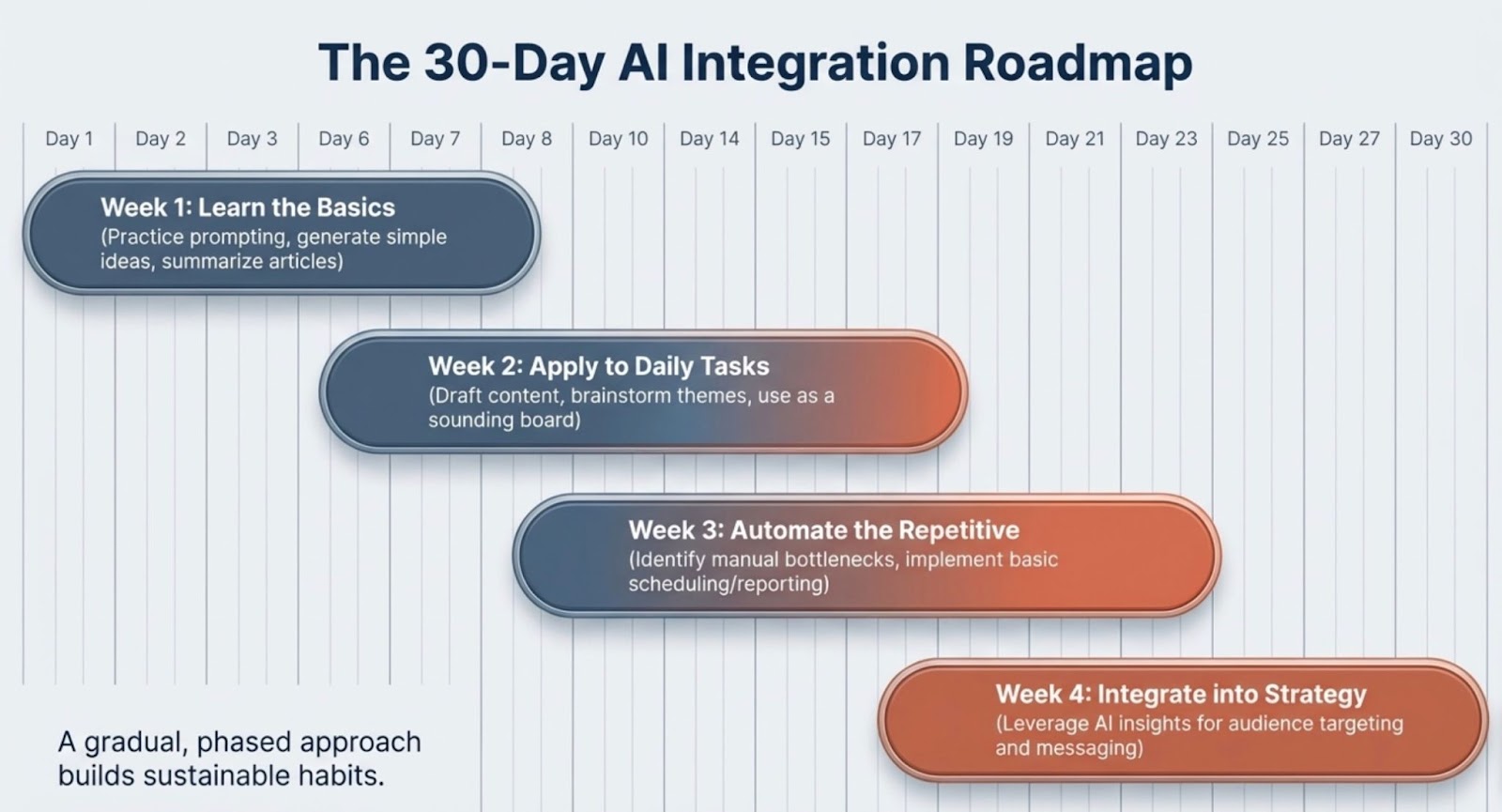
A Simple 30-Day AI Upgrade Plan for Marketers
Marketing professionals who want to begin using AI do not need to completely overhaul their workflows overnight.
A gradual approach often works best.
Week 1 — Learn the Basics
Explore how AI tools work and practice basic prompting techniques.
Try generating marketing ideas or summarizing articles.
Week 2 — Apply AI to Daily Tasks
Use AI tools to assist with content drafts, brainstorming ideas, and summarizing research.
Week 3 — Automate Repetitive Work
Identify repetitive tasks in your workflow and explore automation tools that can handle them.
Week 4 — Integrate AI into Strategy
Use AI insights to support decisions related to audience targeting, campaign messaging, and marketing strategy.
After 30 days, many marketers find that AI tools significantly improve both productivity and creativity.
Conclusion
Artificial intelligence is reshaping the marketing profession, but it is not eliminating the need for marketers.
Instead, AI is transforming how marketing professionals work.
By automating repetitive tasks and accelerating research and analysis, AI allows marketers to focus more on strategic thinking and creative work.
Professionals who learn to collaborate effectively with AI tools may gain a major productivity advantage in the evolving marketing landscape.
Rather than viewing AI as a threat, marketers can see it as a powerful assistant that helps them work smarter.
As AI technology continues to evolve, the most successful marketing professionals will likely be those who remain curious, adaptable, and open to experimenting with new tools.
If you are exploring how AI is reshaping different roles, you may also find these helpful:
References
McKinsey & Company https://www.mckinsey.com
OpenAI https://openai.com
Anthropic Claude AI https://claude.ai
Microsoft Copilot https://copilot.microsoft.com
Perplexity AI https://www.perplexity.ai
Notion AI https://www.notion.so/product/ai
Disclaimer
The information provided in this article is for educational and informational purposes only. Artificial intelligence technologies and tools evolve rapidly, and their capabilities may change over time. The examples and tools mentioned in this article are intended to illustrate potential applications of AI in marketing workflows and should not be interpreted as endorsements or guarantees of specific results. Marketing professionals should evaluate AI tools carefully and consider their organization’s policies, data privacy requirements, and ethical guidelines before integrating AI into their workflows.