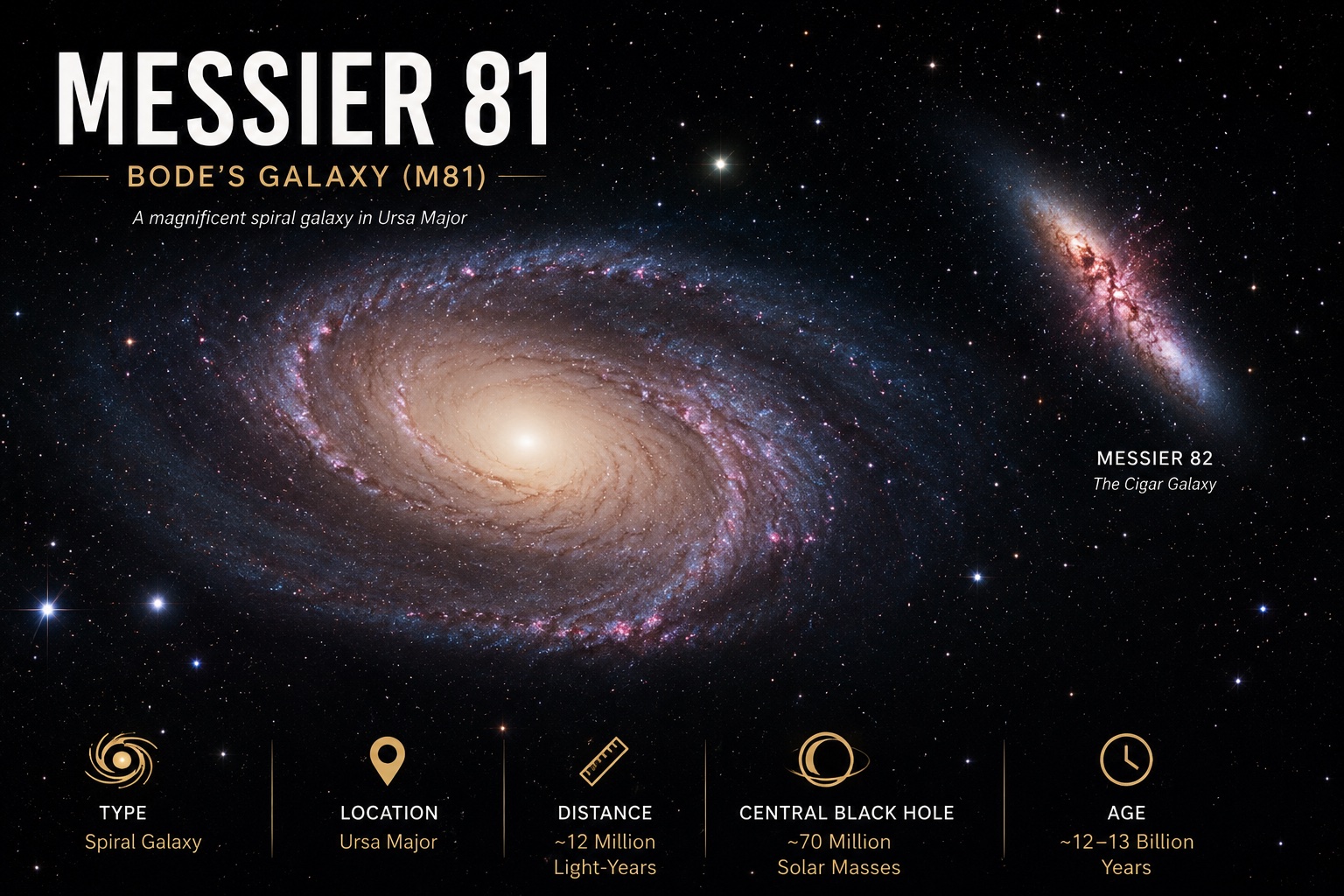
On a clear night beneath dark skies, there are few sights more rewarding for amateur astronomers than discovering a galaxy beyond our own. Among the countless galaxies scattered throughout the universe, Messier 81 stands out as one of the brightest, most beautiful, and most scientifically important. Known both as Messier 81 (M81) and Bode’s Galaxy, this magnificent spiral galaxy offers a fascinating glimpse into the structure and evolution of galaxies similar to our own Milky Way.
Located millions of light-years away, M81 has become a favorite target for stargazers, astrophotographers, and professional astronomers alike. Its graceful spiral arms, active galactic core, and relationship with neighboring galaxies make it one of the most studied objects in the night sky.
What Is Messier 81 (M81)?
Messier 81 is a grand-design spiral galaxy located in the constellation Ursa Major. It was discovered in 1774 by German astronomer Johann Elert Bode, which is why it is often referred to as Bode’s Galaxy.
The Messier 81 galaxy is remarkably similar in structure to the Milky Way. Both galaxies feature a bright central bulge surrounded by sweeping spiral arms filled with stars, gas, and dust. These spiral arms are regions of active star formation where new stars continue to emerge from massive clouds of interstellar material.
Astronomers consider M81 one of the finest examples of a spiral galaxy visible from Earth because its structure is unusually well-defined and relatively easy to observe.
The Discovery of Bode’s Galaxy
Before becoming cataloged as object number 81 in Charles Messier’s famous list of deep-sky objects, M81 was first recorded by Johann Elert Bode.
Bode was searching the skies in the eighteenth century when he identified the faint glow that would later become known as Bode’s Galaxy. Several years afterward, Charles Messier included the object in his catalog, giving rise to the designation Messier 81.
Today, both names remain widely used. Many astronomers prefer the catalog name M81, while others continue to use the historic nickname Bode’s Galaxy in honor of its discoverer.
Messier 81 Location in the Night Sky
The Messier 81 location lies within the northern constellation Ursa Major, home of the famous Big Dipper.
One reason M81 is so popular among amateur astronomers is that it can be found relatively easily. By extending a line from the bowl of the Big Dipper, observers can navigate toward the region where both M81 and M82 reside.
Best Viewing Conditions
To observe M81 successfully, astronomers recommend:
- Dark skies away from city lights
- Moonless nights
- Binoculars or a small telescope
- Spring months in the Northern Hemisphere
Even modest telescopes reveal the galaxy’s bright core, while larger instruments begin to show hints of its elegant spiral structure.
Messier 81 Distance to Earth
The Messier 81 distance to Earth is approximately 12 million light-years.
Although this number is almost impossible to comprehend, it means that the light arriving at Earth tonight began its journey around 12 million years ago. At that time, our early human ancestors had not yet appeared on Earth.
Despite this immense distance, M81 remains one of the brightest galaxies visible from our planet. Its relative closeness on a cosmic scale allows astronomers to study its structure in remarkable detail.
For comparison:
- Distance from Earth to the Sun: 8 light-minutes
- Distance to the nearest star: 4.24 light-years
- Distance to Messier 81: 12 million light-years
The scale of the universe becomes truly apparent when viewing an object like M81.
The Relationship Between Messier 81 and 82
Few galaxy pairs are more famous than Messier 81 and 82.
Located relatively close together in space, these neighboring galaxies have interacted gravitationally for millions of years. While M81 appears calm and orderly, Messier 82—also known as the Cigar Galaxy—looks dramatically different.
Astronomers believe that close encounters between Messier 81 and 82 disrupted large amounts of gas within M82. This triggered an extraordinary period of star formation known as a starburst event.
As a result, M82 is producing new stars at a much faster rate than most galaxies.
The contrasting appearance of these two galaxies makes them one of the most photographed targets in amateur astronomy.
Exploring the Messier 81 Group
Messier 81 is not alone in space. It serves as the dominant member of the Messier 81 Group, a collection of galaxies bound together by gravity.
This galactic neighborhood contains dozens of members, including:
- Messier 82
- NGC 3077
- NGC 2976
- Numerous dwarf galaxies
The Messier 81 Group is one of the closest galaxy groups beyond our own Local Group, which contains the Milky Way and Andromeda galaxies.
Interactions among group members create streams of gas and distortions that provide valuable evidence of how galaxies evolve over time.
The Supermassive Messier 81 Black Hole
At the center of nearly every large galaxy lies a supermassive black hole, and M81 is no exception.
The Messier 81 black hole is estimated to contain roughly 70 million times the mass of our Sun.
By comparison:
- Sagittarius A* (Milky Way): ~4 million solar masses
- Messier 81 black hole: ~70 million solar masses
This enormous object influences the motion of stars and gas near the galactic core. As material spirals inward, it heats up and emits radiation that can be detected by telescopes operating across the electromagnetic spectrum.
Studying the black hole in M81 helps scientists better understand the role these mysterious objects play in shaping galaxies.
How Old Is Messier 81?
The estimated Messier 81 age is approximately 12 to 13 billion years.
This means the galaxy formed relatively early in the history of the universe, not long after the first generations of galaxies began taking shape.
Over billions of years, M81 has:
- Formed countless stars
- Merged with smaller galaxies
- Interacted with neighboring systems
- Developed its present spiral structure
Its long history provides astronomers with a valuable record of galactic evolution.
Comparing Messier 81 to the Milky Way
One reason astronomers are so interested in M81 is that it resembles our own galaxy in many ways.
| Feature | Messier 81 | Milky Way |
|---|---|---|
| Galaxy Type | Spiral | Spiral |
| Diameter | ~90,000 light-years | ~100,000 light-years |
| Age | ~12–13 billion years | ~13 billion years |
| Central Black Hole | ~70 million solar masses | ~4 million solar masses |
| Location | Ursa Major | Local Group |
Because we live inside the Milky Way, it is difficult to see our galaxy’s overall structure. M81 offers an external perspective that helps scientists understand what our own galaxy may look like from afar.
Why Astrophotographers Love M81
Astrophotographers often rank M81 among the most rewarding deep-sky targets.
Its bright core, clearly defined spiral arms, and proximity to M82 make it ideal for imaging. Long-exposure photographs reveal intricate dust lanes and subtle details that are invisible through the eyepiece of most telescopes.
Many stunning images capture both Messier 81 and 82 within a single frame, highlighting the dramatic contrast between a classic spiral galaxy and a starburst galaxy.
Final Thoughts
Messier 81 is far more than a distant smudge of light in the night sky. As one of the nearest and most impressive spiral galaxies, it provides an extraordinary opportunity to study galactic structure, evolution, and interaction.
Whether viewed as Messier 81 (M81), admired as Bode’s Galaxy, examined as part of the Messier 81 Group, or compared alongside Messier 81 and 82, this remarkable galaxy continues to reveal new insights about the universe. Its immense distance from Earth, ancient age, and powerful central black hole ensure that M81 remains one of the most fascinating objects available to both amateur observers and professional astronomers.
Disclaimer
This article is provided for informational and educational purposes only. The views and interpretations expressed are based on publicly available scientific sources at the time of publication. Facts, figures, and scientific understanding may change as new research emerges. Readers should verify critical information through official scientific institutions and peer-reviewed sources when appropriate.