
Artificial Intelligence is no longer a future concept. It is already transforming the global workforce.
From automated customer support to AI-generated content, many companies are adopting AI to reduce costs, increase efficiency, and scale operations faster than ever before.
In 2026, the question many professionals are asking is no longer “Will AI impact jobs?” but rather:
“Which jobs will AI replace first?”
Understanding these trends can help individuals prepare, adapt, and build skills that remain valuable in the age of AI.
The Growing Impact of AI on the Job Market
Artificial intelligence is already reshaping global employment, and several large research organizations have published projections on its potential impact.
For example:
Up to 30% of current work activities could be automated by 2030, according to a major analysis by McKinsey & Company.
A report from Goldman Sachs estimates that generative AI could affect up to 300 million full-time jobs globally.
The World Economic Forum projects that 85 million jobs may be displaced by automation, while 97 million new roles could emerge as technology evolves.
The International Monetary Fund estimates that AI could affect about 40% of jobs worldwide, with even higher exposure in advanced economies.
PwC research suggests that AI could contribute up to $15.7 trillion to the global economy by 2030, driving large-scale adoption across industries.
These projections indicate that AI is not simply replacing jobs—it is transforming the structure of the global workforce.
Even government institutions recognize the impact. The International Monetary Fund estimates that AI could affect around 40% of jobs worldwide, and up to 60% in advanced economies.
This shift is happening because AI excels at tasks involving:
Data processing
Pattern recognition
repetitive workflows
rule-based decisions
large-scale information analysis
Jobs built primarily around these tasks are the most vulnerable.
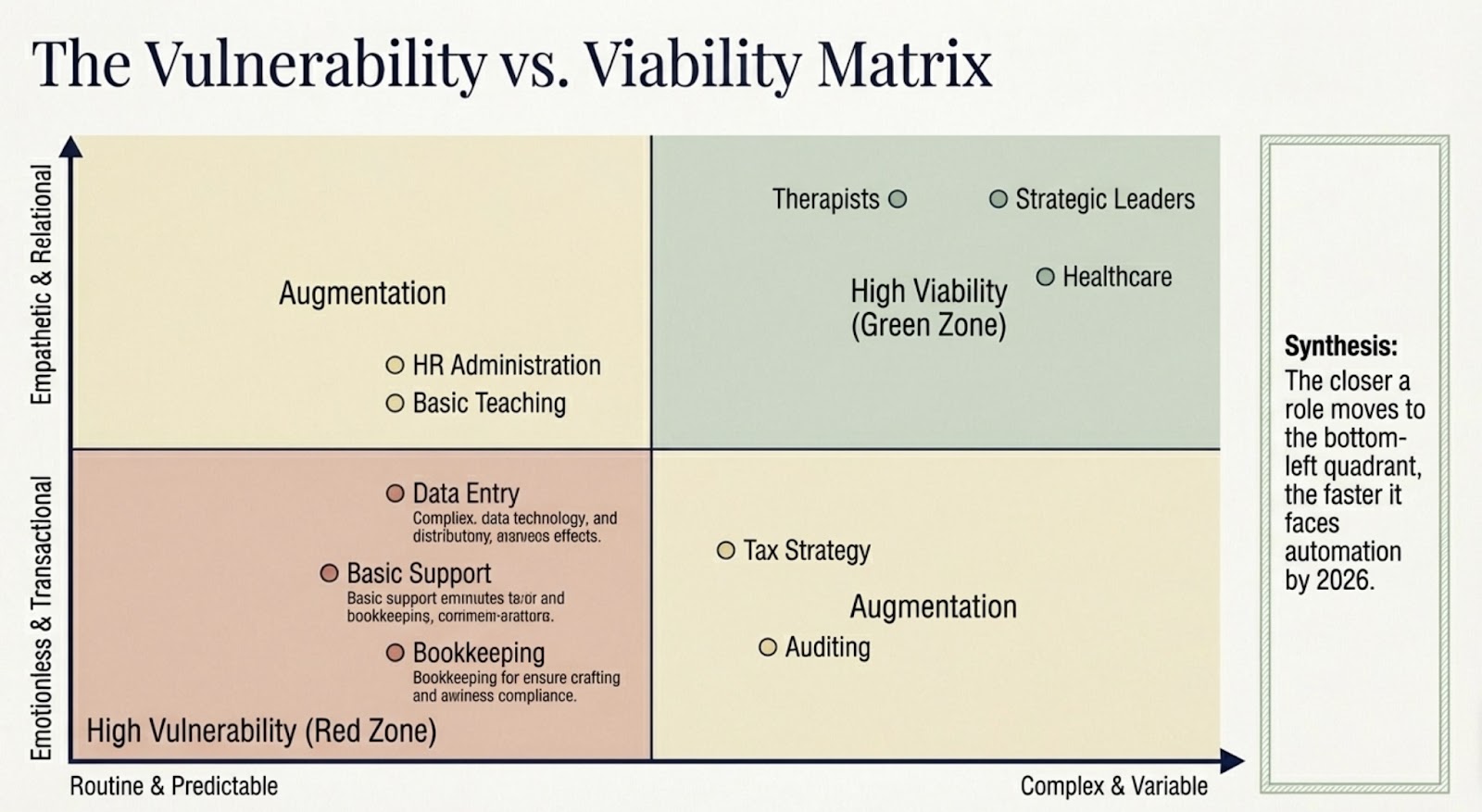
Jobs Most Likely to Be Replaced by AI First in 2026
While AI will not replace every profession, several roles are already experiencing rapid automation.
Below are some of the jobs most likely to be impacted first.
1. Data Entry Clerks
Data entry is widely considered one of the most vulnerable professions to automation.
The role involves transferring information between systems, spreadsheets, and databases—tasks that follow predictable patterns.
Modern AI tools can:
Extract information from documents
Process forms automatically
Organize large datasets
Verify and categorize records
These technologies can perform data entry faster, cheaper, and with fewer errors.
As a result, companies increasingly rely on automated systems instead of manual data entry specialists.
2. Basic Customer Support Agents
Customer support is rapidly being transformed by AI chatbots and virtual assistants.
Today’s AI tools can already handle:
Frequently asked questions
Order tracking
account troubleshooting
basic product inquiries
Many companies now deploy AI chatbots capable of handling thousands of customer conversations simultaneously.
While human agents remain essential for complex or emotional situations, entry-level support roles are increasingly automated.
3. Transcriptionists
Speech-to-text technology has advanced dramatically in recent years.
AI systems can now convert audio to text with extremely high accuracy.
Industries such as:
media
healthcare
legal services
education
have traditionally relied on human transcriptionists.
However, AI tools can now generate transcripts in real time, making manual transcription less necessary.
4. Basic Content Writers
Generative AI tools are capable of producing large volumes of written content.
Examples include:
blog posts
product descriptions
social media captions
marketing copy
Many companies use AI to generate first drafts or large batches of content.
However, human creativity, expertise, and storytelling remain valuable.
Writers who provide insight, originality, and strategic thinking are far less likely to be replaced.
5. Bookkeeping and Basic Accounting
AI accounting platforms can now automatically:
categorize transactions
generate financial reports
detect fraud or anomalies
reconcile accounts
Small businesses increasingly use automated bookkeeping systems rather than manual bookkeeping services.
Accountants will still be needed for higher-level work such as:
tax strategy
financial consulting
auditing
regulatory compliance
But routine accounting tasks are becoming automated.
6. Travel Agents for Standard Bookings
Travel planning has been transformed by digital platforms and AI assistants.
Travelers can now:
compare flights instantly
generate travel itineraries
receive AI-based recommendations
book hotels and activities online
AI travel planners can create complete travel plans in seconds.
As a result, traditional travel agents who focus on basic bookings face declining demand.
However, agents specializing in luxury travel or complex itineraries remain valuable.
Jobs That AI Is Less Likely to Replace Soon
Despite AI’s rapid development, many professions remain difficult to automate.
These jobs rely on qualities that machines cannot easily replicate, including emotional intelligence, creativity, and complex real-world judgment.
Examples include:
Healthcare professionals Teachers and educators Psychologists and therapists Skilled trades (electricians, plumbers, mechanics) Creative artists and designers Leadership and strategy roles
These professions require human understanding, adaptability, and real-world experience.
In many cases, AI will assist these professionals rather than replace them.
The Future of Work: Humans + AI
The future workforce will likely involve collaboration between humans and AI.
Many experts believe the biggest change will not be job elimination but job transformation.
Studies show that many workers already expect AI to automate at least one-third of their tasks in the near future.
Workers who learn to work alongside AI will gain a significant advantage.
Important future skills include:
AI literacy critical thinking problem solving creativity communication strategic decision making
The professionals who thrive in the coming decades will likely be those who use AI as a productivity multiplier.
Final Thoughts
Artificial Intelligence is transforming the way work is done across nearly every industry.
Some jobs will disappear, others will evolve, and entirely new professions will emerge.
History shows that technological revolutions—from the industrial revolution to the internet—often create more opportunities than they destroy.
The key for individuals and organizations is adaptation.
Those who remain curious, flexible, and willing to learn new technologies will be best positioned to succeed in the AI-driven future.
References
You can include this reference section at the bottom of your blog.
McKinsey & Company. The Future of Work After COVID-19 and related automation research. https://www.mckinsey.com
Goldman Sachs Research (2023). The Potentially Large Effects of Artificial Intelligence on Economic Growth. https://www.goldmansachs.com/insights/pages/generative-ai-could-raise-global-gdp.html
World Economic Forum (2023). Future of Jobs Report. https://www.weforum.org/reports/the-future-of-jobs-report-2023/
International Monetary Fund (2024). AI Will Transform the Global Economy. https://www.imf.org/en/Blogs/Articles/2024/01/14/ai-will-transform-the-global-economy
PwC (Global AI Study). Sizing the Prize: What’s the Real Value of AI for Your Business and How Can You Capitalise? https://www.pwc.com/gx/en/issues/analytics/assets/pwc-ai-analysis-sizing-the-prize-report.pdf
Disclaimer
The information presented in this article is intended for educational and informational purposes only. Predictions about artificial intelligence and job automation are based on currently available research, economic forecasts, and industry observations. The future of work may evolve differently depending on technological developments, economic conditions, and policy decisions. This article should not be interpreted as career, financial, or professional advice. Readers should conduct their own research and consult qualified professionals before making career or business decisions.