
Working Smarter in the AI Era — Part 8
Introduction: The New Reality of Online Retail
Running an online retail business today is fundamentally different from just a few years ago.
Competition is no longer local—it’s global. Customers expect instant responses, personalized experiences, and seamless purchasing journeys.
And here’s the key shift:
The retailers who are winning today are not working harder. They are working smarter—with AI.
Artificial intelligence is no longer a futuristic concept reserved for large enterprises. It is now accessible to small and mid-sized online retailers through affordable tools and platforms.
From product recommendations to automated customer service, AI is quietly becoming the backbone of high-performing eCommerce operations.
This article explores how online retailers can leverage AI not to replace human effort—but to amplify efficiency, improve decision-making, and scale faster than ever before.
Why AI Matters More Than Ever in eCommerce
Online retail businesses generate enormous amounts of data every day:
Customer browsing behavior
Purchase patterns
Product performance
Marketing engagement metrics
The challenge is not data collection—it’s what you do with it.
AI transforms raw data into actionable insights in real time.
Instead of guessing:
Which product will sell next
What price converts best
Which customers are likely to churn
AI provides data-driven answers—instantly.
This shift allows retailers to move from reactive operations → predictive strategies.
Core Areas Where AI Transforms Online Retail
1. Product Discovery & Personalization
Customers no longer want to scroll endlessly.
They expect the store to “understand” them.
AI enables:
Personalized product recommendations
Dynamic homepage experiences
Smart search results
Example:
“Customers like you also bought…”
“Recommended based on your browsing history”
Impact:
Higher conversion rates
Increased average order value (AOV)
Improved customer satisfaction
2. Pricing Optimization
Pricing is one of the most powerful—and risky—levers in retail.
AI can analyze:
Competitor pricing
Demand fluctuations
Customer sensitivity
And automatically adjust pricing strategies.
Instead of static pricing:
You move to dynamic pricing optimization
Result:
Maximized margins
Increased competitiveness
Faster response to market changes
3. Inventory & Demand Forecasting
Overstock = wasted cash Understock = lost revenue
AI helps retailers:
Predict demand trends
Optimize stock levels
Reduce dead inventory
Especially critical for:
Seasonal products
Fast-moving consumer goods
Multi-channel sellers
Result:
Better cash flow
Reduced storage costs
Higher product availability
4. Customer Service Automation
Customer expectations:
Instant replies
24/7 availability
AI-powered chatbots and assistants can handle:
Order tracking
FAQs
Return requests
Product inquiries
This reduces:
Support workload
Response time
Operational cost
While improving:
Customer satisfaction
Retention rates
5. AI-Driven Marketing & Content Creation
This is where AI becomes a growth engine.
AI can:
Generate product descriptions
Create ad copy
Write email campaigns
Produce SEO blog content
For online retailers, this means:
Content at scale without scaling headcount.
Example use cases:
Daily product promotions
Automated abandoned cart emails
SEO-driven blog traffic
6. Conversion Rate Optimization (CRO)
AI continuously tests:
Headlines
Images
Layouts
Offers
Instead of manual A/B testing, AI systems can:
Run multiple variations
Learn faster
Optimize automatically
Result:
Higher conversion rates
Better user experience
Continuous improvement
Practical AI Workflow for Online Retailers
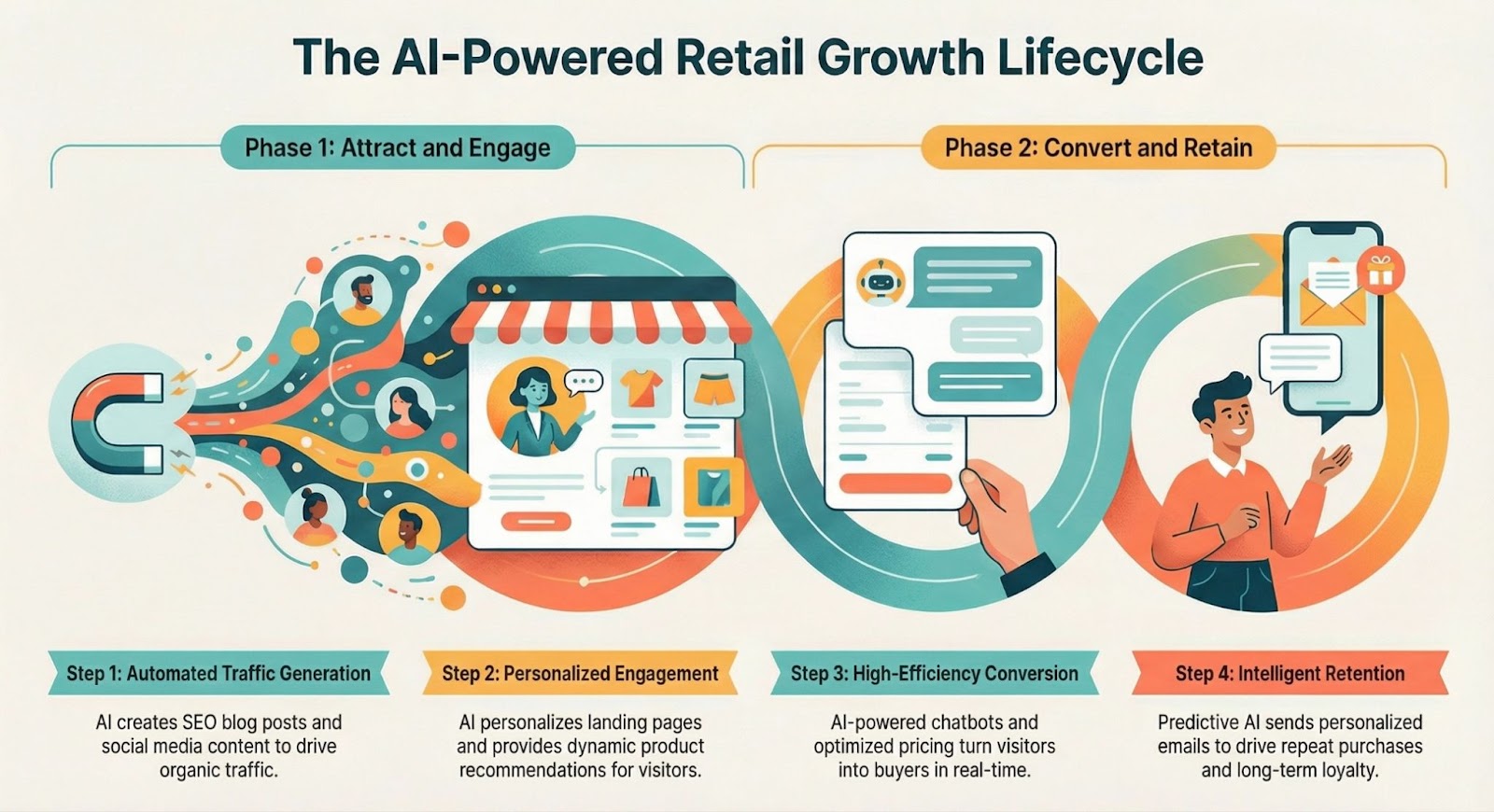
Here’s a simplified AI-powered workflow you can implement:
Step 1: Traffic Generation
AI creates SEO blog posts and social content
Drives organic and paid traffic
Step 2: Engagement
AI personalizes landing pages
Recommends products dynamically
Step 3: Conversion
AI optimizes pricing and offers
AI chatbot assists in real-time
Step 4: Retention
AI sends personalized emails
Predicts repeat purchases
Real-World Impact: What Changes When You Use AI
Without AI:
Manual decisions
Slow execution
Limited scalability
With AI:
Faster decisions
Automated operations
Scalable growth
In practical terms:
One marketer can produce 10x more content
One store can handle 5x more customer inquiries
One business can test hundreds of variations simultaneously
Recommended AI Tools for Online Retailers
(Keep this aligned with your affiliate strategy later)
ChatGPT → Content, product descriptions, automation logic
Shopify AI tools → Product recommendations, store optimization
Klaviyo → AI-driven email personalization
Jasper / Copy.ai → Marketing copy generation
Google Performance Max → AI-powered ad optimization
The Strategic Advantage: Speed + Scale
The biggest advantage AI provides is not just automation.
It’s speed at scale.
Retailers who adopt AI early can:
Launch faster
Test faster
Learn faster
Grow faster
While competitors are still operating manually.
Conclusion: AI Will Not Replace Retailers — But It Will Redefine Them
AI is not replacing online retailers.
But it is redefining what it means to run one.
The future belongs to those who:
Leverage AI for decisions
Automate repetitive work
Focus human effort on strategy and creativity
Because in the AI era:
The smartest retailer is not the busiest one— it’s the one who builds systems that work for them.
Internal Links (Series)
How Marketing Professionals Can Work Smarter with AI
How Product Manager Can Work Smarter with AI
How Accountants Can Work Smarter with AI
How B2B Sales Can Work Smarter with AI
How Students Can Work Smarter with AI
How HR Can Work Smarter with AI
How Data Analysts Can Work Smarter with AI
How Translators Can Work Smarter with AI
How Junior Programmers Can Work Smarter with AI
References
McKinsey & Company — AI in Retail Report
Statista — eCommerce Growth Statistics
Shopify — Future of Commerce Report
Deloitte — AI-Driven Customer Experience
Disclaimer
This article is for informational purposes only. AI tools and strategies evolve rapidly, and results may vary depending on implementation, business model, and market conditions. Businesses should evaluate tools and strategies based on their specific needs before adoption.