Working Smarter in the AI Era — Part 8
Introduction
Trading has always been a battle of information, timing, and discipline.
But in today’s market, something fundamental has changed:
You are no longer competing only with other humans.
You are competing with algorithms.
From hedge funds to retail traders, AI is reshaping how trades are analyzed, executed, and optimized. The question is no longer whether AI will impact trading—it already has.
The real question is:
How can you use AI to gain an edge instead of falling behind?
This guide will show how traders—from beginners to experienced professionals—can work smarter with AI, not harder.
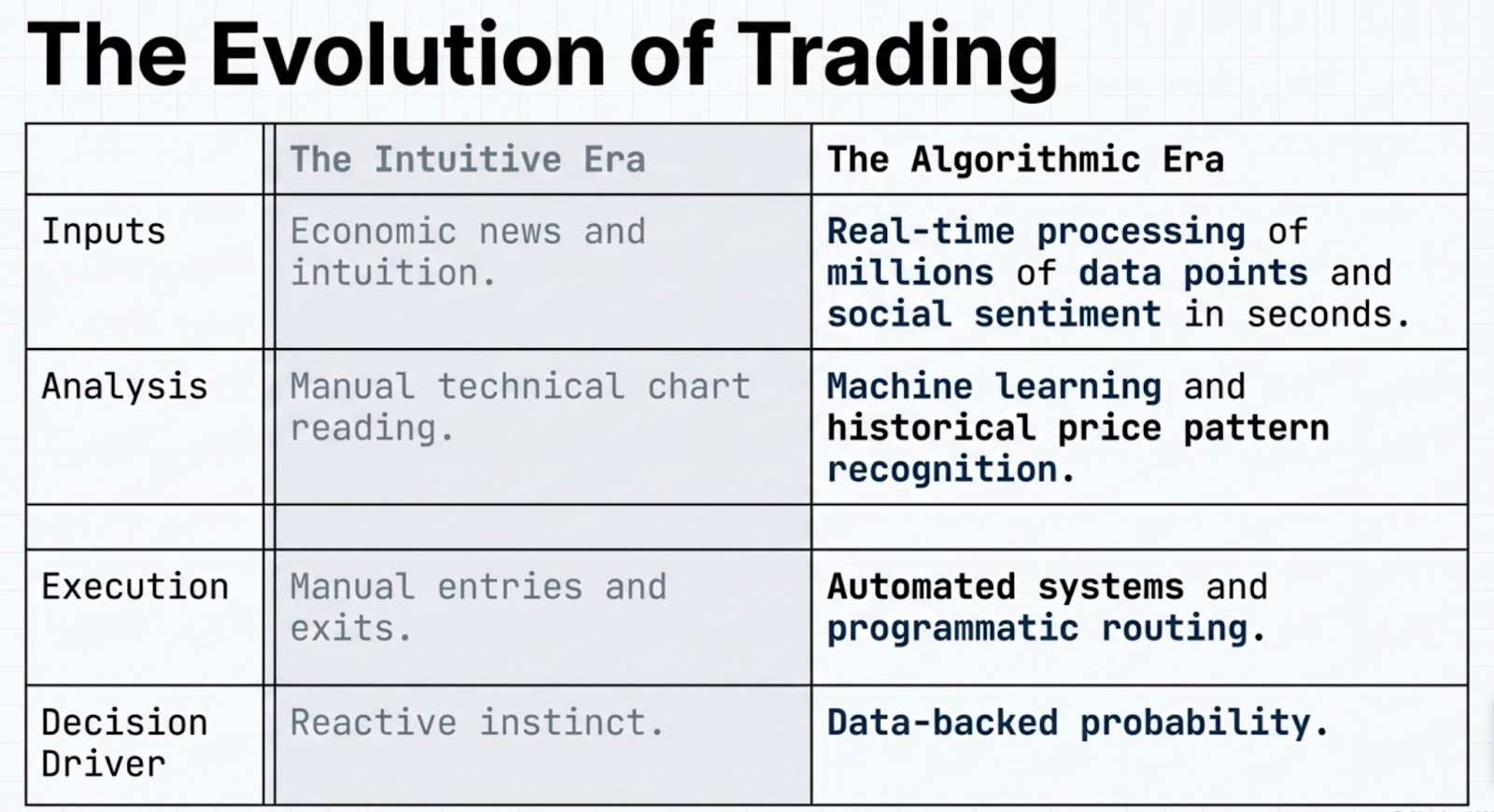
1. The Evolution of Trading in the AI Era
In the past, traders relied on:
Technical charts
Economic news
Experience and intuition
Today, markets move based on:
Real-time data streams
Machine learning models
Automated execution systems
AI can process:
Millions of data points
Historical price patterns
Sentiment from news and social media
All in seconds.
This doesn’t eliminate human traders—it elevates those who know how to use AI effectively.
2. Where AI Fits in a Trader’s Workflow
Think of AI as your co-pilot across the entire trading lifecycle:
1) Idea Generation
Identify trending stocks or sectors
Detect unusual volume or volatility
Surface opportunities you might miss
2) Analysis
Backtest strategies instantly
Analyze correlations across assets
Evaluate risk scenarios
3) Execution
Optimize entry and exit timing
Automate trades based on rules
Reduce slippage and emotional errors
4) Review & Improvement
Track performance patterns
Identify mistakes automatically
Suggest improvements to strategy
3. Key AI Use Cases for Traders
A. AI-Powered Market Research
AI tools can summarize:
Earnings reports
Economic indicators
Breaking news
Instead of reading 10 sources, you get: → One clear, structured insight
B. Sentiment Analysis (The Hidden Edge)
Markets often move based on perception, not reality.
AI can scan:
News articles
Social media
Analyst reports
And detect:
Bullish vs bearish sentiment
Sudden shifts in market mood
This gives traders an early signal before price moves fully reflect it.
C. Strategy Backtesting at Scale
Instead of manually testing strategies:
AI can:
Run thousands of scenarios
Simulate different market conditions
Identify what actually works
This reduces guesswork and increases confidence.
D. Risk Management Optimization
Most traders fail not because of bad ideas—but poor risk control.
AI helps by:
Calculating optimal position sizes
Predicting drawdown scenarios
Adjusting stop-loss levels dynamically
E. Automation & Algorithmic Trading
AI enables:
Rule-based trading systems
Fully automated strategies
24/7 monitoring of markets
This removes:
Emotional trading
Missed opportunities
Fatigue-based mistakes
4. Practical AI Tools Traders Can Use Today
Here are categories (not hype—practical use):
AI Research Tools
ChatGPT / Claude → Summarize news & generate trade ideas
Perplexity → Real-time research
Quant & Backtesting
TradingView (with AI indicators)
QuantConnect
Python + AI libraries
Sentiment & Data
Alternative data platforms
Social sentiment trackers
Automation
Broker APIs (for algorithmic execution)
n8n workflows (your strength area)
5. A Simple AI Workflow for Traders (Practical Example)
Here’s a realistic daily setup:
Step 1 — Market Scan AI scans:
Top movers
News headlines
Volume spikes
Step 2 — Opportunity Filtering AI narrows down:
5–10 potential trades
Based on predefined criteria
Step 3 — Strategy Check AI validates:
Historical success rate
Risk/reward ratio
Step 4 — Trade Execution
Manual confirmation OR automated execution
Step 5 — Performance Feedback AI logs:
What worked
What didn’t
Suggested improvements
6. The Real Advantage: Removing Emotion
Fear and greed are the biggest enemies of traders.
AI helps by:
Enforcing discipline
Following predefined rules
Eliminating impulsive decisions
But here’s the key:
AI should guide decisions—not blindly make them.
7. What AI Cannot Replace
Even in advanced trading environments, AI cannot fully replace:
Market intuition developed over time
Understanding of macroeconomic context
Strategic thinking and adaptability
The best traders will be:
Human judgment + AI execution
8. Risks and Limitations of AI in Trading
AI is powerful—but not perfect.
Be aware of:
Overfitting strategies
False signals from noisy data
Over-reliance on automation
Black-box decision-making
Always:
Validate outputs
Use risk management
Stay in control
9. The Future of Trading Careers
Traders who thrive will:
Understand data, not just charts
Build systems, not just trades
Use AI as a daily tool
The role is evolving from:
“Trader” → “AI-assisted decision-maker”
Conclusion
AI is not here to replace traders.
It’s here to separate those who adapt from those who don’t.
The opportunity has never been greater:
More data
Better tools
Lower barriers to entry
But the competition has never been tougher.
The traders who win in the AI era will not be the fastest or the smartest alone—but the ones who leverage AI the most effectively.
Internal Links (Series)
How Marketing Professionals Can Work Smarter with AI
How Product Manager Can Work Smarter with AI
How Accountants Can Work Smarter with AI
How B2B Sales Can Work Smarter with AI
How Students Can Work Smarter with AI
How HR Can Work Smarter with AI
How Data Analysts Can Work Smarter with AI
How Translators Can Work Smarter with AI
How Junior Programmers Can Work Smarter with AI
How Online Retailers Can Work Smarter with AI
References
McKinsey & Company — The State of AI in Financial Services
JPMorgan — AI in Trading Research
Deloitte — Algorithmic Trading & AI Report
CFA Institute — Machine Learning in Investment Management
Nasdaq — AI and Market Efficiency Studies
Disclaimer
This content is for informational purposes only and does not constitute financial or investment advice. Trading involves significant risk, and past performance does not guarantee future results. Always conduct your own research or consult a qualified financial professional before making investment decisions.