Working Smarter in the AI Era — Part 6
Introduction: HR Is No Longer Just About People—It’s About Intelligence
For decades, Human Resources has been seen as the backbone of organizational culture—focused on hiring, onboarding, compliance, and employee well-being. But today, HR is undergoing one of the most significant transformations in modern business.
Artificial Intelligence is not replacing HR professionals. It is redefining what it means to be one.
In the AI era, HR is evolving from an administrative function into a strategic powerhouse—driven by data, enhanced by automation, and amplified by intelligent decision-making.
The question is no longer:
“Will AI replace HR?”
The real question is:
“How can HR professionals use AI to become more strategic, impactful, and indispensable?”
This article is your practical guide to doing exactly that.
The Evolution of HR: From Administrative to Strategic Partner
Traditionally, HR responsibilities included:
Posting job openings
Screening resumes
Scheduling interviews
Managing payroll and compliance
Conducting annual performance reviews
These tasks are essential—but they are also repetitive, time-consuming, and often reactive.
AI changes the equation.
With AI:
Resume screening becomes intelligent filtering
Interviews become data-informed conversations
Employee feedback becomes real-time insights
Workforce planning becomes predictive rather than reactive
The role of HR shifts from:
“Managing people” → “Designing high-performing organizations”
This shift is where the real opportunity lies.
Where AI Is Already Transforming HR
AI is not a future concept in HR—it is already embedded in daily workflows.
Here are key areas where AI is making immediate impact:
1. Talent Acquisition
Automated resume screening
Candidate-job matching algorithms
AI-generated interview questions
2. Employee Experience
Sentiment analysis from surveys
AI chatbots for HR support
Personalized learning recommendations
3. Performance Management
Continuous feedback tracking
AI-assisted performance summaries
Bias detection in evaluations
4. Learning & Development
Skill gap analysis
AI-curated training paths
Adaptive learning systems
5. Workforce Analytics
Attrition prediction
Hiring success forecasting
Diversity and inclusion insights
The common thread?
AI removes friction so HR can focus on strategy, people, and impact.
The Smart HR Workflow: Before vs After AI
Before AI
Hundreds of resumes reviewed manually
Interview questions prepared from scratch
Performance reviews written once a year
Decisions based on limited data
After AI
AI pre-screens and ranks candidates
Interview frameworks generated instantly
Continuous performance insights available
Decisions backed by real-time data
This is not about working faster.
It’s about working smarter, more consistently, and more strategically.
Practical AI Use Cases for HR Professionals
Let’s move from theory to execution.
1. Resume Screening in Minutes, Not Days
Instead of manually reviewing hundreds of resumes:
Use AI to summarize candidates
Rank applicants based on job fit
Highlight key skills and experience gaps
Example Workflow:
Upload resumes into an AI tool
Define job criteria
Let AI generate a ranked shortlist
Focus your time on top candidates
👉 Result: Faster hiring + better candidate quality
2. Smarter Interview Preparation
AI can generate:
Role-specific interview questions
Behavioral and situational prompts
Candidate-specific follow-up questions
Example: Upload a candidate’s resume → AI suggests tailored questions based on their experience
👉 Result: More meaningful interviews, less guesswork
3. AI-Assisted Performance Reviews
Performance reviews are often:
Time-consuming
Biased
Inconsistent
AI can:
Summarize employee performance data
Identify trends across feedback
Suggest fair, structured evaluations
👉 Result: More objective and consistent reviews
4. Employee Sentiment Analysis
Instead of waiting for annual surveys:
Analyze employee feedback in real time
Detect patterns in engagement
Identify potential burnout or dissatisfaction early
👉 Result: Proactive HR instead of reactive HR
5. Personalized Learning & Development
AI helps HR:
Identify skill gaps across teams
Recommend tailored training programs
Track learning effectiveness
👉 Result: Upskilled workforce aligned with business goals
Tools HR Professionals Should Start Using
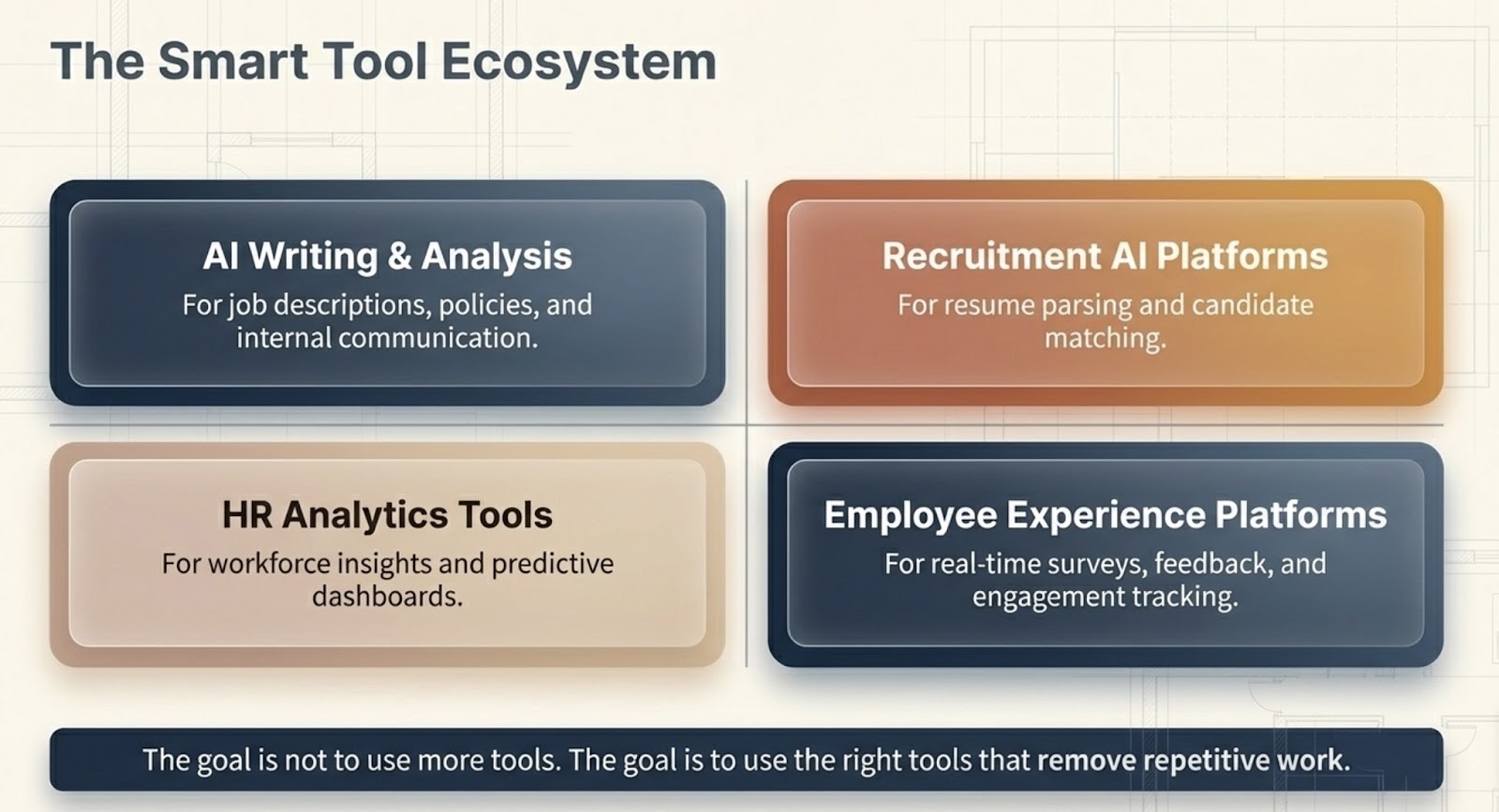
While tools evolve quickly, categories remain consistent:
AI Writing & Analysis Tools
For job descriptions, policies, and communication
Recruitment AI Platforms
Resume parsing, candidate matching
HR Analytics Tools
Workforce insights and dashboards
Employee Experience Platforms
Surveys, feedback, engagement tracking
The goal is not to use more tools.
The goal is to use the right tools that remove repetitive work.
Risks and Ethical Considerations
AI is powerful—but it must be used responsibly.
1. Bias in AI Models
AI can inherit biases from data.
👉 HR must review and validate outputs, not blindly trust them.
2. Over-Automation
Too much automation can remove the human touch.
👉 HR should use AI to enhance—not replace—human judgment.
3. Data Privacy
Employee data must be handled carefully.
👉 Ensure compliance with privacy regulations and internal policies.
A Practical Action Plan for HR Professionals
Here’s how to start—without overwhelming yourself.
Step 1: Identify Repetitive Tasks
Ask:
What tasks consume the most time weekly?
Start there.
Step 2: Introduce AI in One Workflow
Examples:
Resume screening
Interview preparation
Performance summaries
Step 3: Build an AI-Assisted Process
Create a simple system:
Input → AI → Review → Decision
Step 4: Measure Impact
Track:
Time saved
Quality improvement
Hiring speed
Step 5: Expand Gradually
Once one workflow works:
Scale to other HR functions
The Future of HR in the AI Era
The most successful HR professionals will not be those who resist AI.
They will be those who:
Combine human empathy with machine intelligence
Make data-driven decisions without losing the human touch
Shift from administrators to strategic leaders
In this new era, HR is no longer a support function.
It becomes a core driver of business success.
Final Thoughts
AI is not here to replace HR professionals.
It is here to remove the repetitive, the manual, and the inefficient— so HR can focus on what truly matters:
People, culture, and performance.
The opportunity is clear.
Those who learn to work with AI will not only stay relevant— they will become indispensable.
If you are exploring how AI is reshaping different roles, you may also find these helpful:
How Marketing Professionals Can Work Smarter with AI
How Product Manager Can Work Smarter with AI
How Accountants Can Work Smarter with AI
How B2B Sales Can Work Smarter with AI
How Students Can Work Smarter with AI
References
McKinsey & Company — The State of AI in 2023
Deloitte — Global Human Capital Trends Report
Gartner — AI in HR: Transforming Talent Management
Harvard Business Review — How AI Is Changing Human Resources
Disclaimer
This article is for informational purposes only and reflects general industry trends and insights. The tools, workflows, and strategies mentioned may vary depending on organizational context, regulations, and individual use cases. Always evaluate AI solutions carefully and ensure compliance with applicable laws and company policies before implementation.