Working Smarter in the AI Era — Part 5
Artificial intelligence is rapidly transforming how students learn, study, and prepare for their future careers. From personalized learning tools to AI-powered research assistants, students today have access to resources that were unimaginable just a few years ago.
This article is part of the Working Smarter in the AI Era series, where we explore how different groups can use AI to improve productivity and outcomes. If you are interested in how AI is transforming other roles, you can also explore how it is reshaping marketing professionals, B2B sales teams, product managers, and accounting professionals.
But the real opportunity is not replacing students with technology.
The opportunity is helping students learn faster, think deeper, and prepare more effectively for a world where AI is part of everyday life.
In today’s environment, the most successful students are not those who simply study longer hours. They are the ones who learn how to use modern tools to understand concepts better, manage their time efficiently, and apply knowledge in practical ways.
Artificial intelligence allows students to process information more effectively, receive personalized feedback, and explore ideas beyond traditional classroom limits. When used properly, AI helps students focus on what truly matters—understanding, creativity, and problem-solving.
In this article, we explore how students can use AI to improve learning efficiency, enhance research capabilities, strengthen critical thinking, and build skills that will remain valuable in the future.
The Changing Nature of Learning
Over the past decade, education has evolved significantly.
Traditionally, learning focused on textbooks, lectures, and standardized testing.
While these elements still exist, expectations have expanded.
Students are now expected to:
Learn faster
Adapt to new technologies
Solve complex problems
Apply knowledge in real-world scenarios
Continuously update their skills
At the same time, students face increasing challenges:
Information overload from multiple sources
Shorter attention spans due to digital environments
Pressure to perform academically and professionally
Rapidly changing career requirements
Limited time to balance study, life, and personal growth
This creates a complex environment where students must process large amounts of information while staying focused and productive.
Artificial intelligence helps students navigate this complexity by turning information into structured, understandable knowledge.
Instead of relying only on traditional methods, students can combine effort with intelligent tools.
How AI Is Transforming Student Learning
Many tools students already use today include AI capabilities.
Platforms such as learning apps, writing assistants, and research tools are increasingly powered by AI to support education.
Some common AI-powered capabilities include:
Personalized learning recommendations
Instant explanations of complex topics
AI-assisted writing and editing
Automated summarization of materials
Language translation and tutoring
Study planning and time management
These improvements occur because AI enables students to focus on understanding rather than struggling with access to information.
Rather than spending hours searching or organizing content, students can focus on learning and applying knowledge.
Using AI for Smarter Studying
Studying is one of the most time-consuming aspects of student life.
Traditionally, it involves reading, note-taking, memorization, and repetition.
AI-driven tools can significantly improve this process.
These tools can:
Summarize long chapters into key points
Generate practice questions and quizzes
Explain difficult concepts in simpler ways
Create structured study guides
Provide instant feedback on answers
By reducing inefficiencies, students can study more effectively in less time.
AI does not replace studying. It enhances how students study.
Enhancing Research and Information Gathering
Research is a critical skill for students at all levels.
It involves gathering information, evaluating sources, and forming conclusions.
AI tools can accelerate this process.
These tools can:
Summarize academic papers
Identify key insights from large datasets
Suggest relevant sources and topics
Organize research findings
Help structure essays and reports
Students can use these insights to build stronger arguments and deeper understanding.
AI supports research, but critical thinking remains essential in evaluating accuracy and relevance.
Strengthening Critical Thinking
One concern often raised about AI is that it may reduce independent thinking.
However, when used correctly, AI can actually strengthen critical thinking.
Students can:
Compare AI-generated answers with their own understanding
Ask follow-up questions to deepen knowledge
Challenge assumptions and explore alternative perspectives
Use AI as a discussion partner rather than a shortcut
The key is not to accept answers blindly, but to engage with them actively.
This approach helps students develop analytical skills that are essential in the AI era.
Automating Routine Academic Tasks
Students spend a significant amount of time on repetitive tasks.
This includes formatting assignments, organizing notes, and managing schedules.
AI tools can automate many of these tasks, such as:
Formatting essays and citations
Organizing notes and summaries
Managing calendars and deadlines
Creating to-do lists and study plans
When routine tasks are automated, students can focus more on learning and creativity.
The Human Advantage in Learning
Despite the rapid advancement of AI, education remains deeply human.
AI cannot fully replace key capabilities such as:
Creativity
Curiosity
Emotional understanding
Ethical judgment
Original thinking
As AI takes over repetitive tasks, these human capabilities become even more important.
Students who combine AI tools with strong thinking skills will have a significant advantage.
Skills Students Should Develop in the AI Era
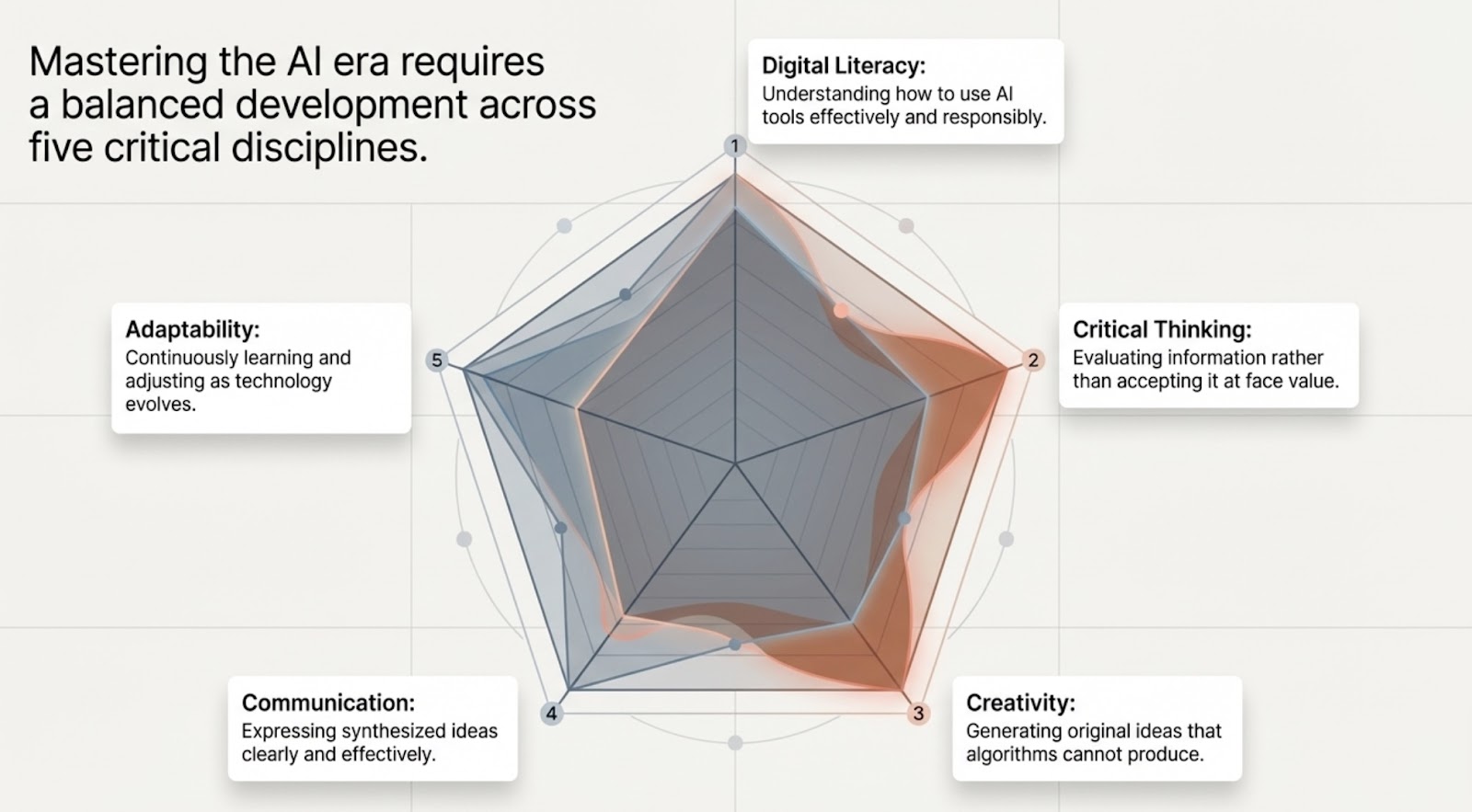
As AI becomes more integrated into education, students should focus on developing key capabilities.
Digital literacy is essential. Students must understand how to use AI tools effectively and responsibly.
Critical thinking is even more important. Students must evaluate information rather than accept it at face value.
Creativity will differentiate students. AI can generate content, but original ideas still come from people.
Communication skills remain vital. Students must express ideas clearly and effectively.
Adaptability is crucial. Technology will continue to evolve, and students must continuously learn and adjust.
The Future of AI in Education
Artificial intelligence will continue to evolve and play a larger role in learning.
Future capabilities may include:
Fully personalized learning experiences
Real-time feedback during studying
AI tutors that adapt to individual needs
Advanced simulation-based learning
Career path recommendations based on skills and interests
However, the role of the student will remain essential.
The most successful students will be those who effectively combine AI tools with curiosity, discipline, and independent thinking.
Final Thoughts
Artificial intelligence is not replacing students.
Instead, it is empowering them to learn more effectively in an increasingly complex world.
By combining human effort with AI-driven support, students can study smarter, understand deeper, and prepare better for the future.
In the modern learning environment, success will belong to those who learn how to work smarter—not just harder.
If you are exploring how AI is reshaping different roles, you may also find these helpful:
How Marketing Professionals Can Work Smarter with AI
How Product Manager Can Work Smarter with AI
How Accountants Can Work Smarter with AI
How B2B Sales Can Work Smarter with AI
References
McKinsey & Company — The Future of Work and Education
Harvard Business Review — AI in Learning and Development
Deloitte — AI in Education Trends
World Economic Forum — Future of Jobs Report
Disclaimer
This article is intended for informational and educational purposes only. The information provided reflects general trends and research related to artificial intelligence and learning environments. It should not be interpreted as academic, career, or professional advice. The effectiveness of AI tools may vary depending on individual learning styles, institutions, and use cases. Students are encouraged to use AI responsibly and continue developing independent thinking and critical analysis skills.