
Working Smarter in the AI Era — Part 4
Artificial intelligence is rapidly transforming how organizations manage financial operations, reporting, and decision-making. From automating routine bookkeeping tasks to enabling predictive financial analysis, AI tools are becoming powerful assistants for accounting professionals.
This article is part of the Working Smarter in the AI Era series, where we explore how different professionals can use AI to improve their work and productivity. If you are interested in how AI is already transforming other functions, you can also explore how AI for marketing professionals, AI in B2B sales, and AI for product managers are reshaping the way teams operate.
But the real opportunity is not replacing accountants with technology. The opportunity is helping accounting professionals work smarter, make better decisions, and spend more time providing meaningful financial insights.
In today’s business environment, the most successful accountants are not those who simply process numbers more efficiently. They are the ones who combine financial expertise with modern technology.
Artificial intelligence allows accounting teams to analyze large amounts of financial data, identify patterns more quickly, and uncover insights that would otherwise remain hidden. When used effectively, AI helps accountants focus their energy where it matters most—supporting business decisions, managing risk, and improving financial performance.
In this article, we explore how accountants can use AI to improve data processing, enhance financial analysis, strengthen advisory capabilities, and remain highly relevant in the modern AI-driven workplace.
The Changing Nature of Accounting
Over the past decade, the role of accountants has evolved significantly.
Traditionally, accounting focused heavily on recording transactions, ensuring compliance, and preparing financial statements.
While these responsibilities remain important, expectations have expanded.
Businesses now require faster reporting, deeper insights, and more forward-looking financial guidance.
At the same time, accounting professionals face increasing complexity:
• Growing volumes of financial data • More complex regulatory requirements • Pressure for real-time reporting • Higher expectations for accuracy and transparency • Increasing demand for strategic financial insights
This creates a challenging environment where accountants must process large amounts of information while delivering timely and accurate results.
Artificial intelligence helps accountants navigate this complexity by turning large datasets into practical insights.
Instead of relying solely on manual processes, accountants can combine experience with data-driven intelligence.
How AI Is Transforming Accounting
Many modern accounting systems already include AI capabilities.
Platforms such as QuickBooks, Xero, and SAP increasingly use artificial intelligence to support financial workflows.
Some common AI-powered capabilities include:
• Automated transaction categorization • Intelligent invoice processing • Real-time anomaly detection • Predictive financial forecasting • Automated reconciliation • Financial trend analysis
According to McKinsey & Company, a significant portion of accounting activities can be automated using current technologies.
These improvements occur because AI enables accounting professionals to focus on high-value activities rather than repetitive tasks.
Rather than spending time processing data, accountants can focus on interpreting results and guiding decisions.
Similar transformations are already happening in other functions, where AI is improving efficiency, personalization, and decision-making across organizations.
Using AI for Smarter Financial Data Processing
Processing financial data is one of the most time-consuming aspects of accounting.
Traditionally, this involves manual entry, classification, and reconciliation of transactions.
AI-driven tools can significantly improve this process.
These tools can:
• Automatically categorize transactions • Extract data from invoices and receipts • Identify discrepancies in financial records • Reconcile accounts more efficiently
By reducing manual effort, accountants can process data faster while minimizing errors.
AI does not replace financial data processing. Instead, it enhances accuracy and efficiency.
Enhancing Financial Analysis
Financial analysis is a critical responsibility for accountants.
It involves reviewing data, identifying trends, and providing insights to support decision-making.
AI tools can analyze large datasets quickly and identify patterns that may not be immediately visible.
These tools can:
• Detect trends in revenue and expenses • Identify cost-saving opportunities • Highlight unusual financial activity • Generate predictive forecasts
Accountants can use these insights to provide more strategic recommendations.
AI supports analysis, but human judgment remains essential in interpreting results and making decisions.
Strengthening Advisory Capabilities
The role of accountants is increasingly shifting toward advisory.
Businesses expect accountants to provide insights that help improve performance and reduce risk.
AI enables this shift by freeing up time previously spent on routine tasks.
With more time available, accountants can:
• Advise on financial strategy • Support budgeting and planning • Evaluate investment decisions • Identify business risks and opportunities
This transition from operational work to advisory work increases the value accountants bring to organizations.
Automating Administrative Tasks
Accounting professionals often spend significant time on administrative work.
This includes documentation, reporting, and system updates.
AI tools can automate many of these tasks, such as:
• Generating financial reports • Summarizing transactions • Updating accounting systems • Creating documentation
When routine tasks are automated, accountants can focus more on strategic and analytical work.
The Human Advantage in Accounting
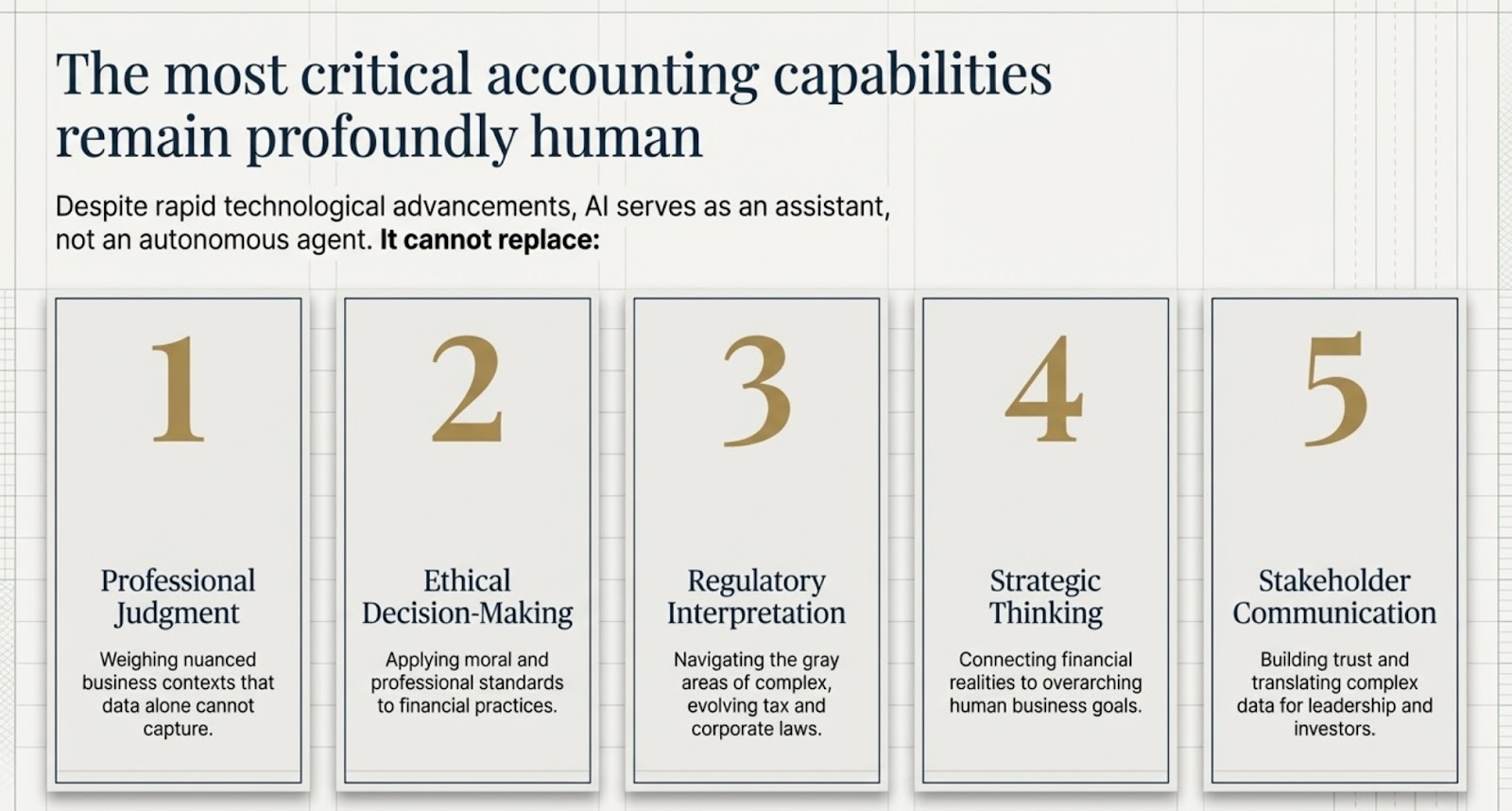
Despite the rapid advancement of AI, accounting remains a profession that requires human expertise.
AI cannot fully replace key capabilities such as:
• Professional judgment • Ethical decision-making • Regulatory interpretation • Strategic thinking • Communication with stakeholders
As AI takes over repetitive tasks, these human capabilities become even more important.
Accountants who combine technical expertise with strong business understanding will have a significant advantage.
Skills Accountants Should Develop in the AI Era
As AI becomes more integrated into accounting workflows, professionals should focus on developing key capabilities.
Data literacy is increasingly important. Accountants must understand how to interpret data and evaluate AI-generated insights.
Business acumen is also essential. Understanding how financial decisions impact overall business performance allows accountants to provide more meaningful advice.
Communication skills remain critical. Accountants must translate complex financial information into clear insights for stakeholders.
Adaptability is another key skill. As technology continues to evolve, accountants must continuously learn and experiment with new tools.
The Future of AI in Accounting
Artificial intelligence will continue to evolve and play a larger role in financial management.
Future capabilities may include:
• Real-time financial insights • Advanced predictive modeling • Automated compliance monitoring • AI-driven financial planning • More sophisticated risk analysis
However, the role of the accountant will remain essential.
The most successful professionals will be those who effectively combine AI capabilities with human judgment, experience, and strategic thinking.
Final Thoughts
Artificial intelligence is not replacing accountants.
Instead, it is enabling them to operate more effectively in increasingly complex environments.
By combining human expertise with AI-driven insights, accountants can process information more efficiently, provide better analysis, and deliver greater strategic value.
In the modern workplace, success will belong to those who learn to work smarter—not just harder.
If you are exploring how AI is reshaping different roles, you may also find these helpful:
References
McKinsey & Company — The Future of Work and Automation
Gartner — Finance and Accounting Technology Trends
Harvard Business Review — AI in Finance and Accounting
Deloitte — AI Transformation in Finance
Disclaimer
This article is intended for informational and educational purposes only. The information provided reflects general trends and research related to artificial intelligence and professional workflows. It should not be interpreted as career, financial, or business advice. The adoption and effectiveness of AI tools may vary depending on industry, organization, and individual circumstances. Readers are encouraged to evaluate technologies carefully and consider professional guidance when making strategic decisions.