
Working Smarter in the AI Era — Part 8
Translation is one of the professions most directly affected by artificial intelligence. That does not automatically mean translators are disappearing. It means the job is changing faster than many others.
That change can feel uncomfortable at first. When AI can generate a first-pass translation in seconds, it is easy to wonder where human value still fits. But that question misses the bigger opportunity. The future of translation is not simply human versus machine. It is expert human judgment combined with AI speed.
For translators who adapt well, AI can reduce repetitive work, speed up terminology research, improve consistency, support quality checks, and free up more time for the parts of the job that actually require human skill: nuance, context, tone, brand voice, culture, persuasion, domain expertise, and accountability. Recent industry data shows that machine translation is already used in more than half of professional translation work in key segments, while generative AI is entering workflows for editing, quality control, terminology, research, and content support. At the same time, many professionals remain cautious, which shows that adoption is real, but mature usage is still developing.
This is exactly why this moment matters. Translators who learn how to use AI well are not just becoming faster. They are repositioning themselves as language specialists who deliver more value than raw translation alone.
In this article, we will look at how translators can work smarter with AI, where AI genuinely helps, where it still falls short, what practical workflows make sense, and how translators can protect quality, trust, and their careers in an AI-driven market.
The reality translators are facing now
The translation profession is under pressure, but it is not obsolete. In the United States, interpreters and translators had about 75,300 jobs in 2024, with a median annual wage of $59,440. Employment is projected to grow 2% from 2024 to 2034, slower than the average for all occupations, while around 6,900 openings per year are still expected over the decade. About 27% of workers in the field are self-employed, which also highlights how freelance and flexible this profession remains.
At the same time, broader labor-market trends suggest translators are among the occupations more exposed to language-model capabilities. The Science paper based on the “GPTs are GPTs” research estimated that roughly 80% of the U.S. workforce could have at least 10% of tasks affected by LLMs, and about 19% could see at least 50% of tasks affected. The paper does not say those jobs vanish. It says a meaningful portion of their tasks can be accelerated or reshaped by AI.
That distinction is important. AI exposure is not the same as full replacement. In translation, AI is strongest at speed, pattern recognition, drafting, and predictable language transformation. Humans still matter most when the work requires subtle meaning, legal or medical risk judgment, transcreation, audience sensitivity, negotiation of ambiguity, multilingual brand alignment, and final accountability.
The World Economic Forum’s Future of Jobs Report 2025 reinforces this bigger picture. It found that 86% of employers expect AI and information processing technologies to transform their business by 2030, 39% of workers’ current skills are expected to be transformed or become outdated by 2030, and 85% of employers plan to prioritize upskilling.
For translators, the message is clear: this is a reskilling moment, not a surrender moment.
Why AI is not the enemy for translators
The fear around AI usually comes from imagining AI as a cheaper substitute for human language work. And yes, that does happen in low-stakes, high-volume, low-budget situations. Some buyers will absolutely use AI to cut costs.
But that is not the whole market.
Serious organizations still need trustworthy communication. They still need someone who can catch legal risk, preserve brand tone, localize intent, handle terminology correctly, manage multilingual content systems, and make sure the final output is fit for purpose. AI can assist that process, but it does not take responsibility for it.
In fact, the more AI-generated content floods the market, the more valuable careful human review can become.
That creates a shift in how translators should position themselves. Instead of selling only word conversion, they can increasingly sell outcomes such as:
accurate multilingual communication
AI-assisted post-editing
terminology management
multilingual QA
transcreation and localization
style-guide enforcement
multilingual content adaptation
subtitle and media localization review
regulated-content review
human sign-off for high-risk materials
This is a stronger professional position than simply competing on per-word rates for raw translation.
What the data says about AI use in translation
Professional adoption is real, but not universal.
The 2025 European Language Industry Survey reported that machine translation is now used in more than 50% of professional translation work among both language companies and independent professionals. For language companies specifically, actual MT use reached 50% of handled projects, and AI use entered at 34%. Among independent professionals, respondents using MT in 50% or more of their projects increased from 16% in 2024 to 29% in 2025.
The same survey also showed mixed business effects. Among language companies, 52% reported a direct negative impact from AI overall, but among companies that had implemented AI themselves, 48% reported improved efficiency and productivity, 31% reported expanded service offerings, and 35% reported reduced costs.
That is one of the most important signals in the whole discussion. AI can hurt translators who ignore it or compete only on commodity work. But it can benefit translators and language businesses that learn how to integrate it intelligently.
A separate 2025 survey of professional translators found that 29.4% already use generative AI in their workflow, while 70.6% do not use it at all. Among users, GenAI was typically used as one tool among many, not as the entire workflow. On average, GenAI users used it 32.6% of the time, and only 28.8% used it more than half the time. ChatGPT was the most widely used system among GenAI users at 80.8%, followed by Microsoft Copilot at 29.6%.
That tells us something practical. The winning model is not “let AI do everything.” The winning model is selective integration.
The smartest way for translators to think about AI
The best mindset is this:
AI is your first-pass assistant, not your final authority.
That means using AI where it is fast and useful, while keeping human review where meaning, trust, and nuance matter. In practice, translators can divide their work into three zones.
Zone 1: Tasks AI handles well
These are the areas where AI can save time immediately:
Initial draft translation for low-risk content Terminology suggestions Glossary extraction Phrase alternatives Summaries of source documents Rephrasing awkward segments Style adaptation experiments QA support for consistency checks Subtitle rough drafts Research assistance for background context Formatting help Translation-memory adjacent support Draft email or chat translation for internal use
These uses fit what current research and survey data show: translators often use GenAI for writing-related support such as contextual meanings, rephrasing, simplifying, shortening, summarizing, and synonym finding.
Zone 2: Tasks AI can support but not own
These require strong human supervision:
Marketing translation Website localization E-commerce product descriptions Customer support scripts Training materials Presentation decks Video subtitle adaptation SEO localization Multilingual social content Brand tone adaptation
In these cases, AI can create a useful base, but human judgment is needed to preserve tone, naturalness, and market relevance.
Zone 3: Tasks that still need strong human control
These are the most defensible translator services:
Legal translation Medical translation Clinical or pharmaceutical content Regulatory documents Financial disclosures Contracts Sensitive HR communications Executive speeches Crisis communication Literary translation Luxury branding Culturally sensitive campaigns Anything where error cost is high
For this work, AI can still help with support tasks, but the translator remains the decision-maker.
Practical ways translators can use AI right now
Here is where the article becomes useful in day-to-day work. Translators do not need to reinvent their business overnight. They can start by using AI in a few focused ways.
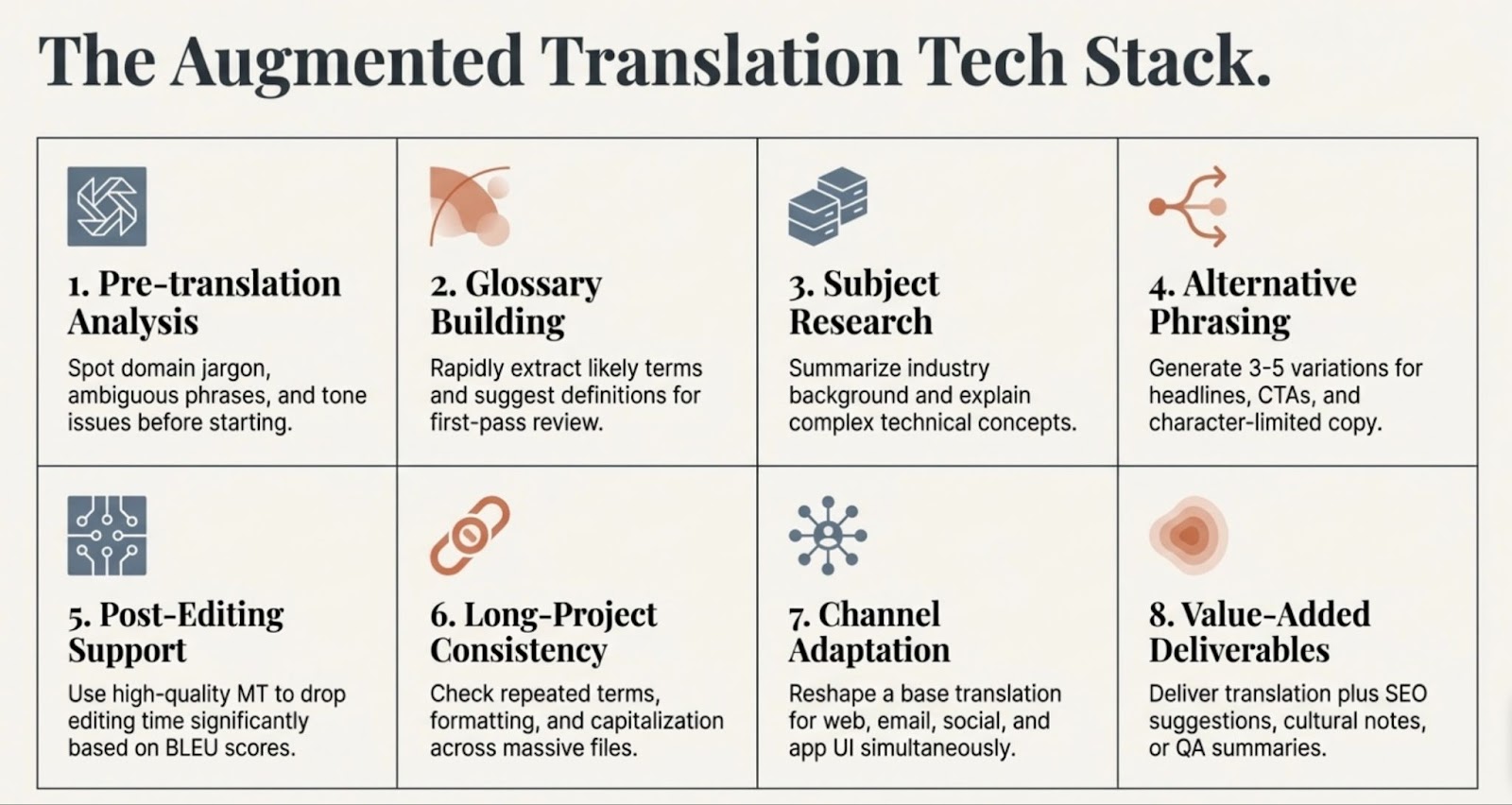
1. Use AI for pre-translation analysis
Before translating, paste a section of source text into an AI system and ask for:
terminology candidates
domain-specific jargon
ambiguous phrases
possible audience issues
tone analysis
cultural references that may not localize well
This can reduce the time spent discovering issues halfway through the project.
2. Build better glossaries faster
AI is excellent at pulling likely terms from source material. It can suggest definitions, alternatives, and context examples. It should not replace verified terminology sources, but it can accelerate the first pass dramatically.
That matters because terminology consistency is one of the fastest ways to improve translation quality and client trust.
3. Speed up research on unfamiliar subjects
Specialist translation often slows down because of research, not the writing itself. AI can help summarize industry background, compare definitions, explain concepts in plain language, and flag related terms to verify.
For example, a translator working on biotech, SaaS, law, or manufacturing content can use AI to understand the subject faster before making final terminology decisions.
4. Use AI to generate alternative phrasings
Sometimes the first translation is accurate but stiff. AI can be useful for generating three to five alternative phrasings in the target language.
This is especially helpful for:
headlines
call-to-action lines
marketing copy
app microcopy
subtitles with character limits
social captions
taglines
The translator still chooses the best version, but the brainstorming time drops.
5. Use AI for post-editing support, not blind acceptance
Research on post-editing has repeatedly shown productivity benefits when MT quality is strong enough. One study found NMT post-editing allowed substantial time savings with equal or slightly better quality in a banking and finance setting. Another study found that for each 1-point increase in BLEU score, post-editing time dropped by about 3–4%, showing that MT quality strongly affects productivity.
The important lesson is not “always use MT.” It is “use the right MT or AI output in the right context.” Low-quality AI output can waste time. High-quality output in a controlled domain can save a great deal of it.
6. Use AI to check for consistency across long projects
AI can quickly help compare repeated terms, headings, product names, capitalization, formatting patterns, and phrasing consistency across long files.
This is valuable for manuals, websites, catalogs, and multilingual content sets where consistency can easily slip.
7. Use AI to adapt content for channel-specific localization
Many translators are now doing more than traditional translation. Clients increasingly need one message adapted across website pages, email, social posts, app UI, product pages, and subtitles.
AI can help reshape a base translation into multiple channel-ready versions faster, while the translator ensures each one still feels natural and appropriate.
8. Use AI to create value-added deliverables
A translator can now deliver more than translated text. For example:
translation + terminology sheet
translation + style note
translation + cultural adaptation comments
translation + SEO keyword localization suggestions
translation + subtitle timing recommendations
translation + QA summary
translation + multilingual content variants
This makes the translator harder to replace because the service becomes more strategic.
A sample AI-assisted workflow for translators
A smart workflow might look like this:
First, review the source text manually and identify risk level. Second, use AI to extract terminology, summarize subject matter, and flag ambiguous passages. Third, run a first-pass translation through approved MT or AI tools if the content is appropriate. Fourth, post-edit carefully with focus on meaning, tone, target-culture fit, and terminology. Fifth, use AI again for consistency checks, missing-term checks, and phrasing alternatives. Sixth, do a final human-only review without relying on the AI output. Seventh, deliver the translation with any value-added notes the client will appreciate.
This workflow is where productivity gains become real without sacrificing professional standards.
Where translators should be careful
AI can absolutely help translators. It can also cause expensive mistakes.
Hallucinations
Generative AI can invent meanings, references, or terminology. That is especially dangerous for rare terms, legal wording, technical content, and low-resource language pairs. Even research on translator use of GenAI notes that hallucinations remain a real risk.
Confidentiality
Some client material should never be pasted into public AI tools without permission. Translators working with legal, corporate, medical, or confidential business materials need to understand data policies clearly.
Over-trusting fluency
AI output often sounds smooth even when it is wrong. This is one of the biggest traps. Fluency is not accuracy.
Cultural flattening
AI tends to produce average, statistically likely phrasing. That can remove distinctiveness, local relevance, emotional nuance, or brand personality.
Quality degradation in premium work
For literary, luxury, legal, regulatory, and highly persuasive content, weak AI-assisted editing can make work sound generic. In those cases, speed gains may cost more than they save.
The skills translators should build now
If 39% of workers’ current skills are expected to be transformed or outdated by 2030, then translators should not only improve language skill. They should upgrade their workflow skill.
The translators most likely to thrive will be strong in six areas.
1. AI literacy
Understand what AI is good at, what it is bad at, and how to evaluate output critically.
2. Prompting for language work
Good prompting can save real time. Translators should learn how to ask for tone comparisons, glossary extraction, ambiguity spotting, alternative phrasings, and structured QA help.
3. Domain expertise
The more specialized the translator, the harder they are to replace. Law, medicine, life sciences, fintech, manufacturing, gaming, audiovisual localization, and B2B tech all reward specialist knowledge.
4. Editing and post-editing excellence
As AI handles more drafting, human value shifts toward review, refinement, and fit-for-purpose judgment.
5. Cultural and audience intelligence
Clients do not only need word conversion. They need communication that works in a market.
6. Advisory positioning
Translators who can advise clients on localization risk, multilingual consistency, terminology, brand voice, and workflow efficiency become much more valuable than translators who sell only by the word.
New opportunities translators can create with AI
This is where the conversation gets more exciting.
AI does not just change how translators work. It can expand what they offer.
A translator can become:
a localization consultant a multilingual QA specialist a transcreation partner a subtitle adaptation editor a multilingual SEO content localizer an AI post-editing specialist a terminology and style-guide manager a multilingual prompt and content reviewer a localization workflow designer a human reviewer for AI-generated multilingual content
These roles may grow precisely because so much raw content is now generated quickly and needs human oversight.
That is the overlooked opportunity. When content volume explodes, review, adaptation, and quality assurance often become more valuable.
How freelance translators can stay competitive
Freelancers especially need a clear strategy.
Competing only on price is dangerous in the AI era. Competing on trusted expertise is stronger.
A freelance translator can stay competitive by doing the following:
Position around specialization, not generic language ability. Offer AI-assisted speed with human-reviewed quality. Explain what kinds of content you do and do not handle with AI. Create service tiers, such as raw MT review, full post-editing, premium human translation, and transcreation. Build a repeatable glossary and style-guide process. Market yourself as someone who reduces communication risk, not just someone who swaps words. Show examples of tone-sensitive or domain-sensitive work. Learn basic multilingual content operations, not only translation itself.
Clients increasingly want partners who understand workflow, consistency, and business use cases.
What in-house translators and language teams should do
In-house teams have a slightly different challenge. They need to show they are not just a cost center.
AI can help in-house translators demonstrate value by enabling faster turnaround, more internal support, multilingual governance, and better content quality across departments.
A strong internal language team can become the organization’s expert layer for:
approved AI translation workflows
multilingual brand standards
terminology governance
secure language-tool use
escalation rules for high-risk content
review policies
language quality metrics
vendor coordination
market-appropriate localization guidance
That is much more strategic than simply translating inbound requests.
What clients still need from human translators
Even when clients say they want AI, most of them still want outcomes that require humans.
They want to avoid embarrassment. They want to avoid legal mistakes. They want to protect brand tone. They want native-sounding copy. They want consistency. They want someone accountable. They want quality when it matters.
That means the translator’s job is increasingly to connect language quality to business risk and business results.
That positioning is powerful because it is true.
Final thoughts
Translator is one of the clearest examples of a profession being reshaped by AI in real time. The evidence is already visible: machine translation is deeply embedded in workflows, generative AI is entering day-to-day professional practice, and the market is forcing change.
But the lesson is not that translators are finished.
The real lesson is that translators who stay purely in manual, repetitive, commodity-style work may feel the most pressure, while translators who combine language expertise with AI literacy can become faster, more strategic, and more valuable.
The winners in this field will not be the people who reject AI blindly. They will also not be the people who trust AI blindly. They will be the professionals who know when to use it, when to question it, and when human judgment must lead.
That is what working smarter with AI looks like for translators.
Internal Links (Series)
How Marketing Professionals Can Work Smarter with AI
How Product Manager Can Work Smarter with AI
How Accountants Can Work Smarter with AI
How B2B Sales Can Work Smarter with AI
How Students Can Work Smarter with AI
How HR Can Work Smarter with AI
How Data Analysts Can Work Smarter with AI
References
U.S. Bureau of Labor Statistics, Occupational Outlook Handbook: Interpreters and Translators.
World Economic Forum, The Future of Jobs Report 2025.
ELIS 2025, European Language Industry Survey 2025.
Farrell, “Survey on the use of generative artificial intelligence by professional translators,” 2025.
Läubli et al., “Post-editing Productivity with Neural Machine Translation,” ACL Anthology.
Sanchez-Torron and Koehn, “Machine Translation Quality and Post-Editor Productivity.”
Eloundou et al., “GPTs are GPTs: Labor market impact potential of LLMs.”
Disclaimer
This article is for informational and educational purposes only and does not constitute career, legal, financial, or professional advice. AI tools, translation platforms, privacy rules, and market conditions change quickly. Translators should evaluate tools carefully, verify accuracy, protect confidential client information, and follow applicable legal, contractual, and ethical requirements before using AI in professional workflows.