Working Smarter in the AI Era — Part 7
Introduction
There has never been a more uncertain time to start a career as a programmer.
You’ve probably seen the headlines: “AI writes code.” “Developers will be replaced.” “Entry-level jobs are disappearing.”
For junior programmers, this creates a very real fear — Where do I fit in?
But here’s the reality most people are missing:
AI is not eliminating opportunities. It is reshaping what “valuable” looks like.
The junior programmers who struggle will be the ones trying to compete with AI on speed. The ones who succeed will be those who learn how to use AI as leverage.
This shift is not about coding less. It’s about thinking better, building faster, and learning smarter.
The New Role of a Junior Programmer
Traditionally, junior programmers were expected to:
Write basic functions
Fix small bugs
Handle repetitive coding tasks
Learn by doing manual work
But AI is now handling much of that.
That means your role is evolving into something more powerful:
👉 From code writer → to problem solver 👉 From task executor → to system thinker 👉 From slow learner → to accelerated builder
Your value is no longer defined by how much code you can write. It’s defined by how effectively you can build solutions using AI.
Where Junior Programmers Waste Time Today
Before we talk about AI advantages, let’s be honest about where time is usually lost:
Googling syntax repeatedly
Debugging blindly without direction
Writing repetitive boilerplate
Searching Stack Overflow for similar issues
Getting stuck for hours on small problems
These are exactly the areas where AI shines.
5 High-Impact Ways Junior Programmers Should Use AI
1. AI as Your Coding Mentor (Not Just a Tool)
Instead of asking: “Write this function for me”
Ask:
“Explain why this code works”
“What are edge cases here?”
“How would a senior engineer improve this?”
This turns AI into a real-time mentor, not just a code generator.
👉 Result: You learn faster than traditional junior programmers ever could.
2. AI for Debugging Faster (Your #1 Time Saver)
Debugging is where juniors lose the most time.
With AI, you can:
Paste error messages and get explanations
Ask for step-by-step debugging approaches
Identify root causes instead of guessing
👉 Instead of: 2–3 hours stuck 👉 You get: 5–15 minutes to resolution
3. AI for Understanding Large Codebases
One of the hardest parts of being junior is understanding existing systems.
AI can help you:
Summarize files and modules
Explain architecture
Map relationships between components
👉 This dramatically reduces onboarding time.
4. AI for Writing Better Code (Not Just Faster Code)
AI can help improve code quality by:
Suggesting cleaner structures
Refactoring messy code
Enforcing best practices
Improving readability
👉 You don’t just write code faster — you write like a more experienced developer.
5. AI for Learning New Technologies Rapidly
Instead of spending days reading documentation:
Use AI to:
Break down concepts simply
Compare frameworks
Generate example projects
Create learning roadmaps
👉 What used to take weeks can now take days.
The Skills That Matter More Than Ever
AI does not eliminate skill — it changes which skills matter.
Junior programmers should now focus on:
1. Problem Framing
Knowing what to build is more valuable than knowing how to type it.
2. Prompting Skills
Your ability to communicate with AI directly impacts output quality.
3. Code Understanding (Not Memorization)
You don’t need to memorize syntax — you need to understand what the code does.
4. System Thinking
How components connect matters more than individual lines of code.
5. Curiosity & Iteration
The best juniors are not the smartest — they are the fastest learners.
A Practical Daily Workflow with AI
Here’s how a smart junior programmer should work today:
Step 1 — Define the problem clearly → What are you trying to build or fix?
Step 2 — Ask AI for approach options → “Give me 3 ways to solve this problem.”
Step 3 — Generate a starting solution → Use AI as a draft, not the final answer
Step 4 — Review and understand the code → Ask: “Explain this line by line.”
Step 5 — Improve and optimize → “How can this be more efficient?”
Step 6 — Test and validate → Always verify — never blindly trust
Common Mistakes Junior Programmers Make with AI
Let’s address the biggest risks:
❌ Blindly Copy-Pasting Code
→ Leads to shallow understanding
❌ Over-Reliance on AI
→ Weakens problem-solving skills
❌ Not Verifying Outputs
→ AI can produce incorrect logic
❌ Skipping Fundamentals
→ You still need core concepts
The Competitive Advantage (This Is Huge)
Here’s the truth most people don’t realize:
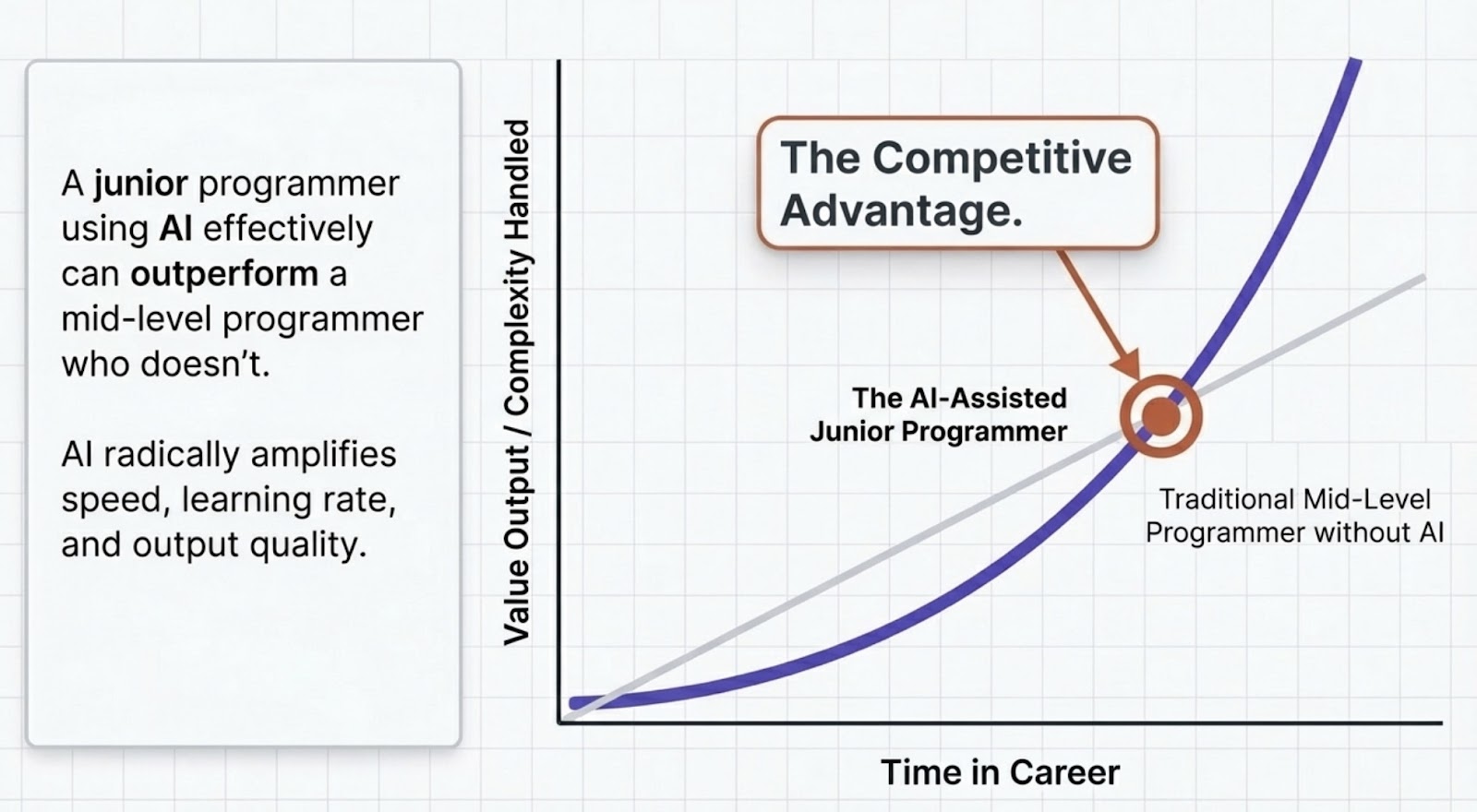
A junior programmer using AI effectively can outperform a mid-level programmer who doesn’t.
Why?
Because AI amplifies:
Speed
Learning rate
Output quality
This creates a massive gap between those who adopt AI early and those who don’t.
The Future of Junior Programming Roles
Entry-level roles are not disappearing. They are evolving into:
AI-assisted developers
Rapid prototypers
Technical problem solvers
Builders who can ship quickly
Companies are not looking for: “People who write code slowly”
They are looking for: “People who can build solutions fast.”
Final Thoughts
If you are a junior programmer today, you are not late. You are early — if you adapt correctly.
AI is not your competition. It is your biggest advantage.
The goal is simple:
👉 Don’t try to out-code AI 👉 Learn to out-think and out-use AI
That is how you stay relevant. That is how you grow faster than anyone else.
Internal Links (Series)
How Marketing Professionals Can Work Smarter with AI
How Product Manager Can Work Smarter with AI
How Accountants Can Work Smarter with AI
How B2B Sales Can Work Smarter with AI
How Students Can Work Smarter with AI
How HR Can Work Smarter with AI
How Data Analysts Can Work Smarter with AI
How Translators Can Work Smarter with AI
References
McKinsey Global Institute — The Economic Potential of Generative AI
GitHub — Developer Productivity Report (Copilot)
Stack Overflow — Developer Survey Trends
OpenAI — AI and Software Development Productivity Studies
Disclaimer
This article is for informational purposes only and reflects general trends in AI and software development. It does not guarantee career outcomes or job security. Individual results may vary depending on skill level, experience, and market conditions.