
Working Smarter in the AI Era — Part 3
Artificial intelligence is rapidly transforming how organizations build and manage products. From analyzing customer feedback to prioritizing features and accelerating development cycles, AI tools are becoming powerful assistants for product managers.
This article is part of the Working Smarter in the AI Era series, where we explore how different professionals can use AI to improve their work and productivity. If you are interested in how AI is already transforming other functions, you can also explore how AI for marketing professionals and AI in B2B sales are reshaping the way teams operate.
But the real opportunity is not replacing product managers with technology. The opportunity is helping product managers work smarter, make better decisions, and spend more time creating meaningful value for customers.
In today’s competitive markets, the most successful product managers are not those who simply work harder. They are the ones who combine human judgment with modern technology.
Artificial intelligence allows product teams to analyze large amounts of data, understand customer needs more deeply, and identify opportunities that would otherwise remain hidden. When used effectively, AI helps product managers focus their energy where it matters most—solving real customer problems and delivering impactful products.
In this article, we explore how product managers can use AI to improve customer research, streamline documentation, prioritize more effectively, and accelerate innovation in the modern AI-driven environment.
The Changing Nature of Product Management
Over the past decade, the role of product managers has evolved significantly.
Modern product teams operate in environments where customer expectations are constantly increasing, competition is intensifying, and product cycles are becoming shorter.
Customers today expect seamless digital experiences, continuous improvements, and personalized solutions. They provide feedback across multiple channels, including app reviews, support tickets, social media, and direct interactions.
At the same time, product managers face growing complexity:
• Larger volumes of customer data • Faster release cycles • Cross-functional coordination across global teams • Increasing reliance on data-driven decision-making • Higher expectations for product outcomes
This creates a challenging environment where product managers must process large amounts of information while making timely and strategic decisions.
Artificial intelligence helps product managers navigate this complexity by turning large datasets into practical insights.
Instead of relying solely on intuition, product managers can combine experience with data-driven intelligence.
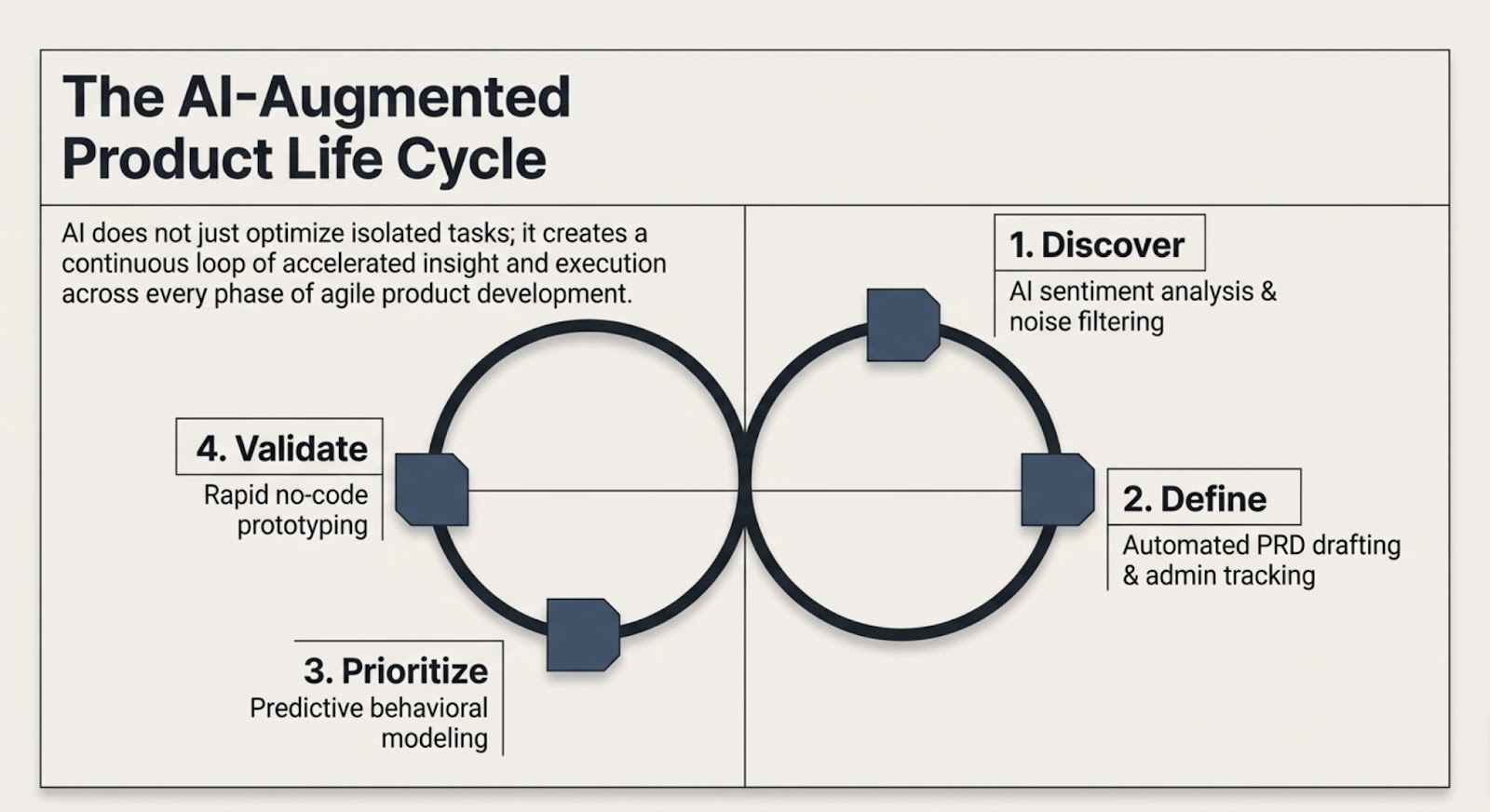
How AI Is Transforming Product Management
Many modern product tools already include AI capabilities.
Analytics platforms, customer feedback systems, and product management tools increasingly use artificial intelligence to support decision-making.
Some common AI-powered capabilities include:
• Customer feedback analysis • Feature usage insights • Predictive analytics • Automated documentation • Workflow optimization • Experimentation support
According to research from McKinsey & Company, organizations that effectively use AI in product development can significantly improve speed, efficiency, and decision quality.
These improvements occur because AI enables teams to focus on high-impact activities rather than manual analysis.
Rather than spending time processing information, product managers can focus on defining strategy and delivering outcomes.
Similar transformations are already happening in other functions, where AI is helping teams improve targeting, personalization, and decision-making—particularly in AI for marketing professionals and AI in B2B sales.
Using AI for Smarter Customer Research
Understanding customer needs is one of the most important responsibilities of a product manager.
Traditionally, this involves reviewing feedback from multiple sources, including interviews, surveys, and support channels.
This process can be time-consuming and difficult to scale.
AI-driven tools can analyze large volumes of feedback and identify patterns quickly.
These tools can:
• Summarize customer comments • Identify recurring issues • Detect sentiment trends • Highlight emerging needs
For example, if multiple users report similar challenges, AI can group these signals together and highlight them as key areas of concern.
Product managers can then prioritize improvements based on real customer insights.
AI does not replace customer research. Instead, it helps product managers process information more efficiently and uncover insights faster.
Improving Product Documentation
Writing clear and structured documentation is an essential part of product management.
Product requirement documents (PRDs), feature descriptions, and internal communications must be detailed and aligned across teams.
Creating these documents manually can take significant time and effort.
AI writing tools can assist product managers by generating structured drafts based on inputs such as:
• Problem statements • User personas • Business goals • Feature requirements
These tools can also help refine language, improve clarity, and ensure consistency.
Product managers still define the direction and make key decisions. AI simply helps accelerate the documentation process.
Enhancing Prioritization and Decision-Making
Prioritizing features and initiatives is one of the most challenging aspects of product management.
Decisions often involve balancing customer needs, business objectives, technical constraints, and available resources.
AI can support prioritization by analyzing data such as:
• User behavior patterns • Feature adoption rates • Customer feedback trends • Historical performance data
By identifying patterns and correlations, AI can provide additional context for decision-making.
For example, it can highlight which features are most likely to improve user engagement or reduce churn.
Product managers still make the final decisions, but AI provides valuable insights that reduce uncertainty and improve confidence.
Accelerating Product Experimentation
Testing ideas quickly is critical for modern product development.
Traditionally, building prototypes and running experiments required significant engineering resources.
AI and no-code tools now allow product managers to accelerate this process.
They can:
• Generate initial design concepts • Create simple prototypes • Define test scenarios • Analyze experiment results
This enables faster validation of ideas and reduces the risk of investing in low-impact features.
By shortening feedback loops, product teams can innovate more effectively.
Automating Administrative Tasks
Product managers often spend a large portion of their time on administrative work.
This includes documenting meetings, updating systems, tracking progress, and communicating status updates.
AI tools can automate many of these tasks, such as:
• Meeting summaries • Task tracking • Status reporting • Documentation updates
When routine work is automated, product managers can focus more on strategic thinking and product development.
This shift allows teams to operate more efficiently and deliver better results.
The Human Advantage in Product Management
Despite the rapid advancement of AI, product management remains a highly human-centered role.
Successful products are built by understanding real user needs, making strategic trade-offs, and aligning teams around a shared vision.
AI cannot replace several critical capabilities:
• Strategic thinking • Customer empathy • Cross-functional leadership • Decision-making under uncertainty • Long-term vision
As AI takes over more analytical and repetitive tasks, these human capabilities become even more important.
Product managers who combine data-driven insights with strong leadership skills will have a significant advantage.
Skills Product Managers Should Develop in the AI Era
As AI becomes more integrated into product workflows, product managers should focus on developing key capabilities.
Data literacy is increasingly important. Product managers must understand how to interpret data and evaluate insights generated by AI.
Strategic thinking remains essential. AI can provide recommendations, but product managers must define direction and priorities.
Communication skills are also critical. Product managers must translate complex insights into clear actions for stakeholders.
Adaptability is another key skill. As tools and technologies evolve, product managers must continuously learn and experiment with new approaches.
The Future of AI in Product Management
Artificial intelligence will continue to evolve and play a larger role in product development.
Future capabilities may include:
• Real-time product insights • Automated roadmap recommendations • Advanced user behavior modeling • AI-driven product simulations • More intelligent experimentation systems
However, the role of the product manager will remain essential.
The most successful product managers will be those who effectively combine AI capabilities with human judgment, creativity, and leadership.
They will not rely on AI alone but will use it as a tool to enhance their decision-making and execution.
Final Thoughts
Artificial intelligence is not replacing product managers.
Instead, it is enabling them to operate more effectively in increasingly complex environments.
By combining human expertise with AI-driven insights, product managers can better understand customers, make smarter decisions, and deliver more impactful products.
In the modern marketplace, success will belong to those who learn to work smarter—not just harder.
If you are exploring how AI is reshaping different roles, you may also find these helpful:
• How Marketing Professionals Can Work Smarter with AI • How B2B Sales Professionals Can Work Smarter with AI
References
McKinsey & Company. The economic potential of generative AI https://www.mckinsey.com
Gartner. Product Management and AI Trends https://www.gartner.com
Harvard Business Review. How AI Is Changing Product Development https://hbr.org
OpenAI. Generative AI in Business Applications https://openai.com
Disclaimer
This article is intended for informational and educational purposes only. The information provided reflects general trends and research related to artificial intelligence and professional workflows. It should not be interpreted as career, financial, or business advice. The adoption and effectiveness of AI tools may vary depending on industry, organization, and individual circumstances. Readers are encouraged to evaluate technologies carefully and consider professional guidance when making strategic decisions.